Spiega documentation
- Knowledge sharing
- Portfolio
Motorway drivers
In this project the attention is to know the distribution of cars entering and exiting the motorway.
We have tried different approaches to solve the problem and we have defined some KPIs to have a quantitative evaluation of the perfomances of each model.
- tile counts
- routing and via points
- analyzer
- postprocessing
- matrix KPIs
- fixing-asymmetry
- topics on router
- postprocessing routing
The focus of this project is to understand where motorway drivers enter and exit a particular junction of a motorway as described in this ticket .
The overview of the parquet files is used to compare the different analyzer runs.
Filtering
We have selected 12 junctions on a isolated motorway (A4) crossing Germany on the east-west axis.
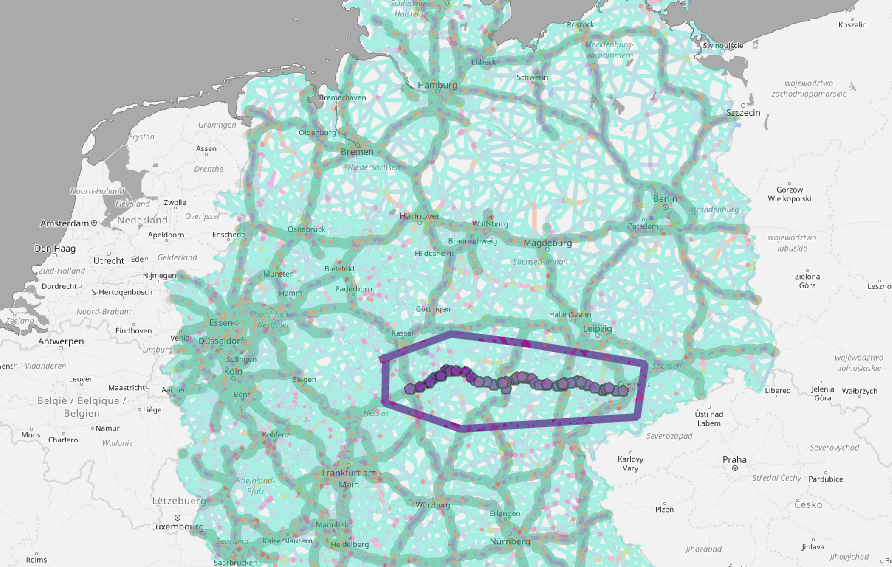
selected motorway stretch
Chains from the tripEx are filtered via a pre validation script.
Tile counts
We try to obtain the same information on tile counts.
For each junction we have to correctly report the incoming and outcoming flux.
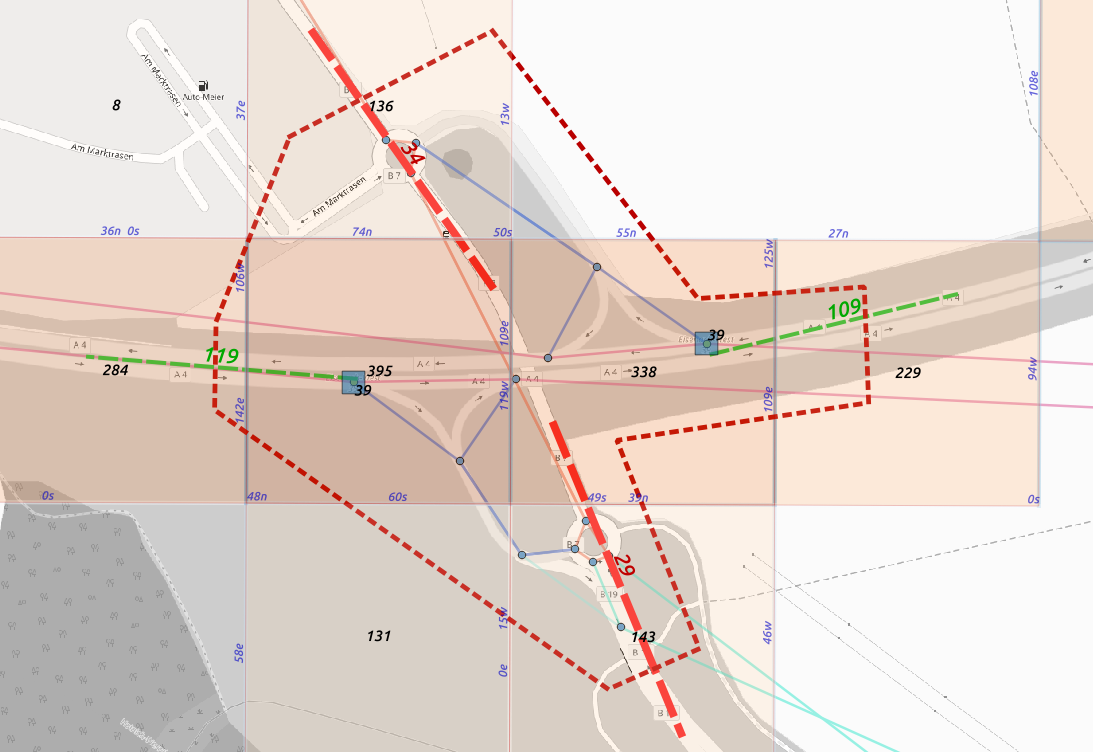
counts across tiles
Postprocessing routing
Building the network
We keep junctions in the network which are labelled differently from the other street classes.
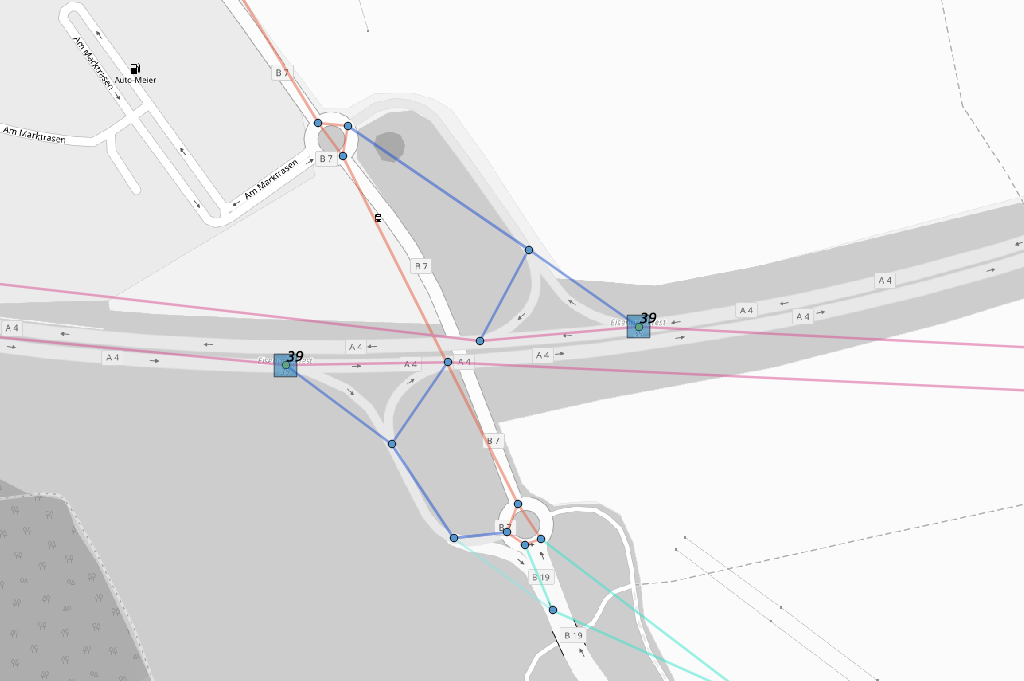
junctions into network
local motorway structure
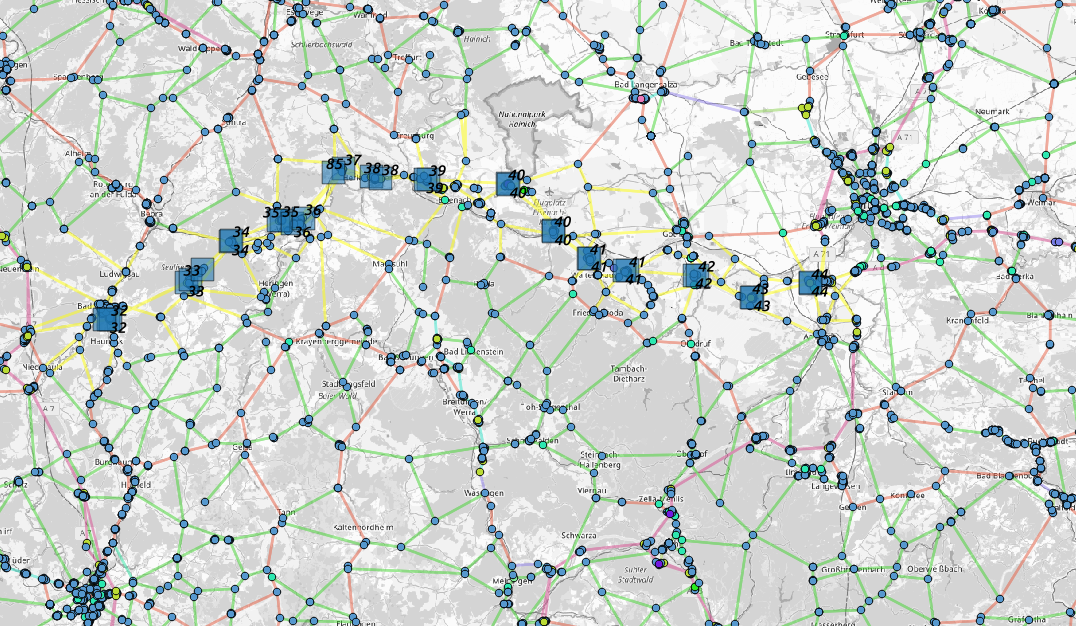
local motorway structure
routing, wrong weighting
Weighting the graph
We worked at the correct weighting between highway classes:
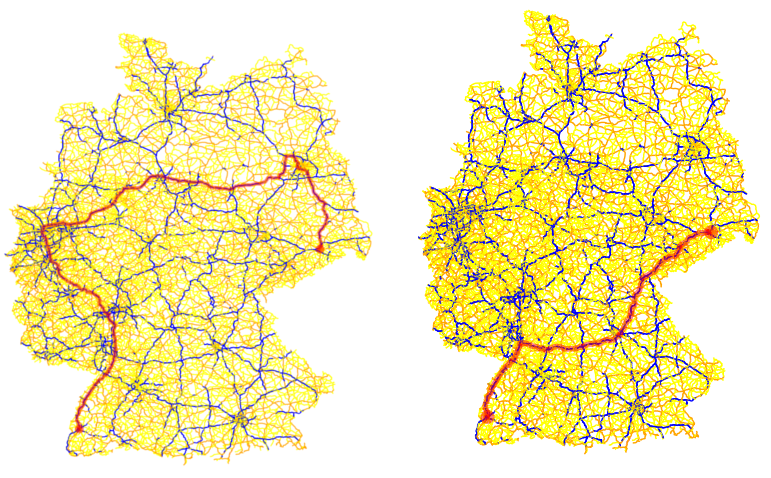
routing, improve in weighting
empirical definition of weights that led to qualitative good routing solutions.
if edge[2]['highway']=='motorway':
    attrs['weight'] = edge[2]['length']*1
elif edge[2]['highway']=='primary':
    attrs['weight'] = edge[2]['length']*1.5
elif edge[2]['highway']=='secondary':
    attrs['weight'] = edge[2]['length']*1.8
else:
    attrs['weight'] = edge[2]['length']*3
precomputing distances
We took a random node for each zip code and we calculate the shortest route between each other zip code zip2zip .
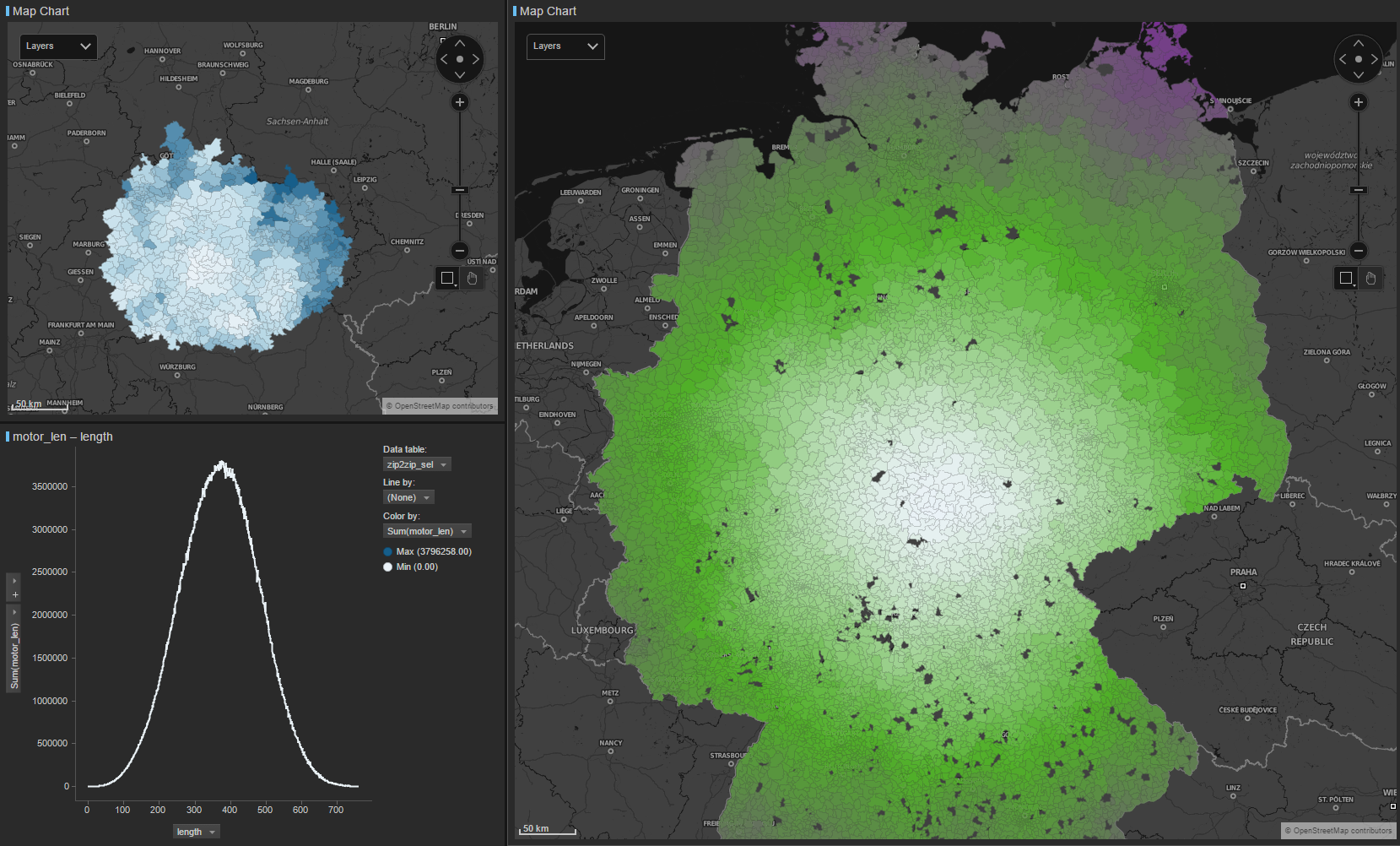
zip 2 zip distances
For each zip2zip relation we identified the first and last junction crossed by the route.
ODM
we than processed an ODM between all zips in Germany for 9 days and we joined it with the precomputed zip2zip junction relation to count how many trips are probably routed via motorway junctions.
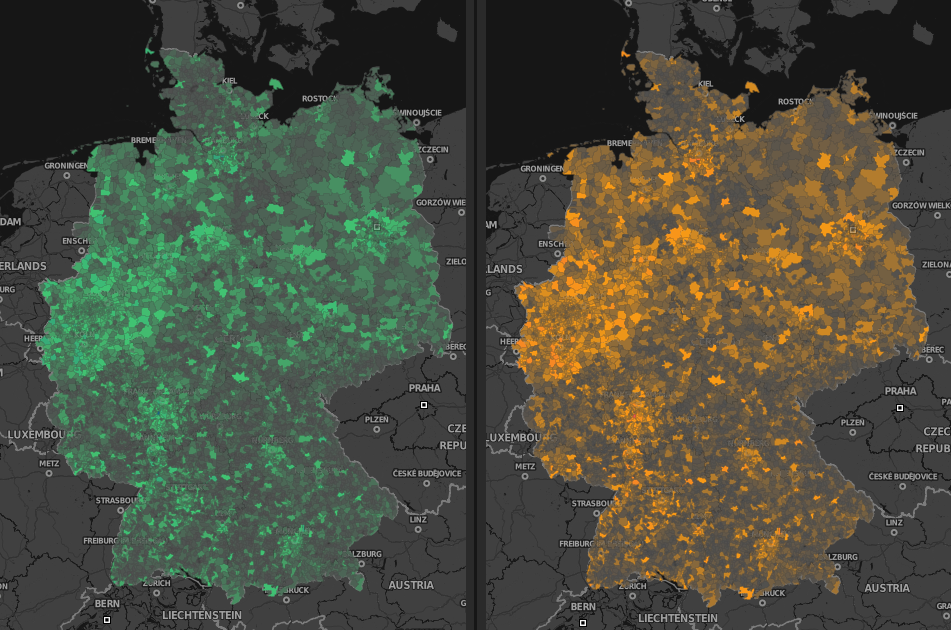
odm on 9 days
We run an ODM with a short and a long break parameter to see the difference in counts and understand where people could have a break on the way.
enter2exit table
After iterating on all steps of the process,
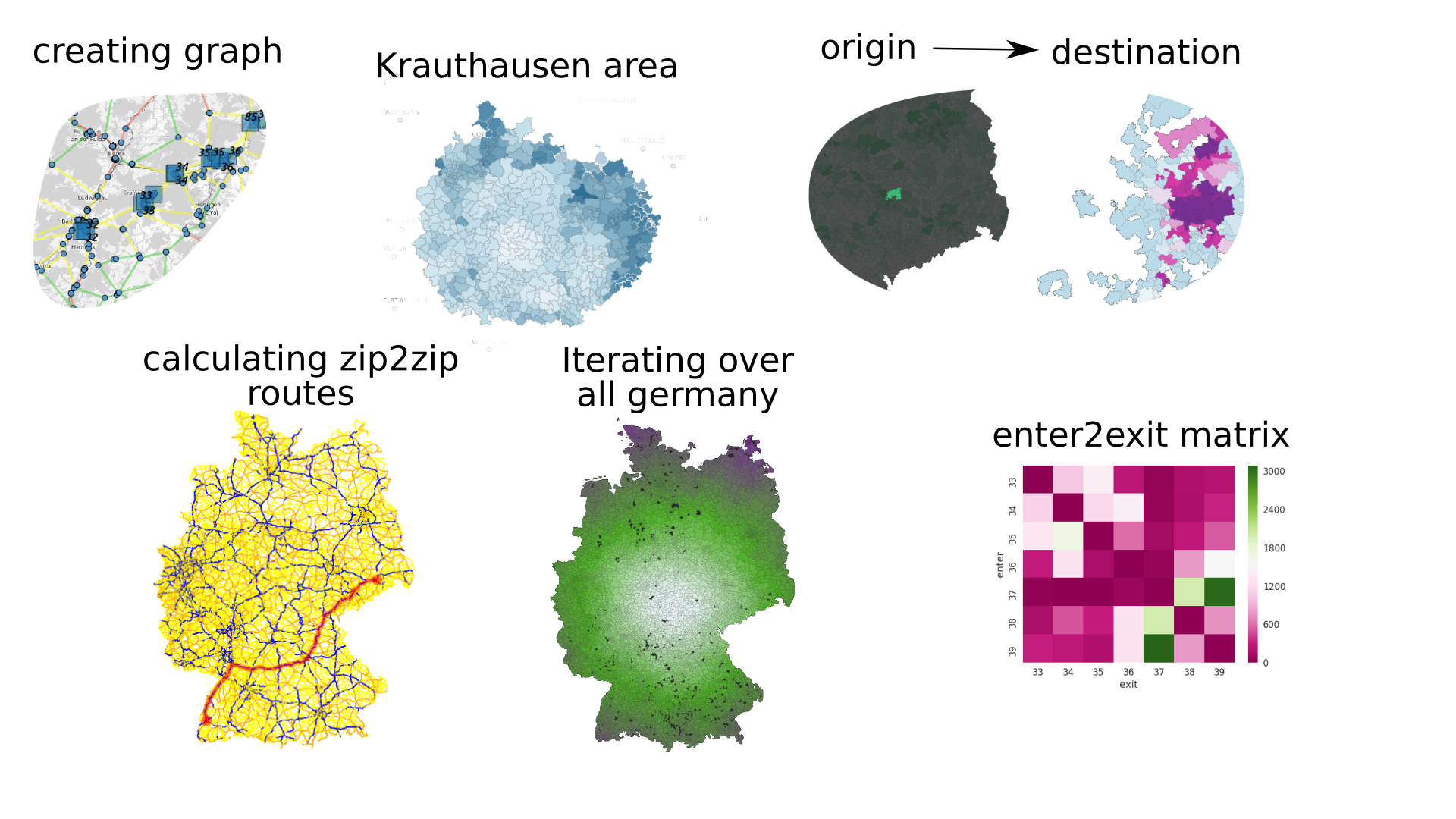
we have created the enter to exit relationship matrix.

enter2exit via postprocessing
routing and via points
We realized with an ODM via that the counts of people leaving the motorway wasn't consistent and we couldn't fix the unbalance between junctions in post processing.
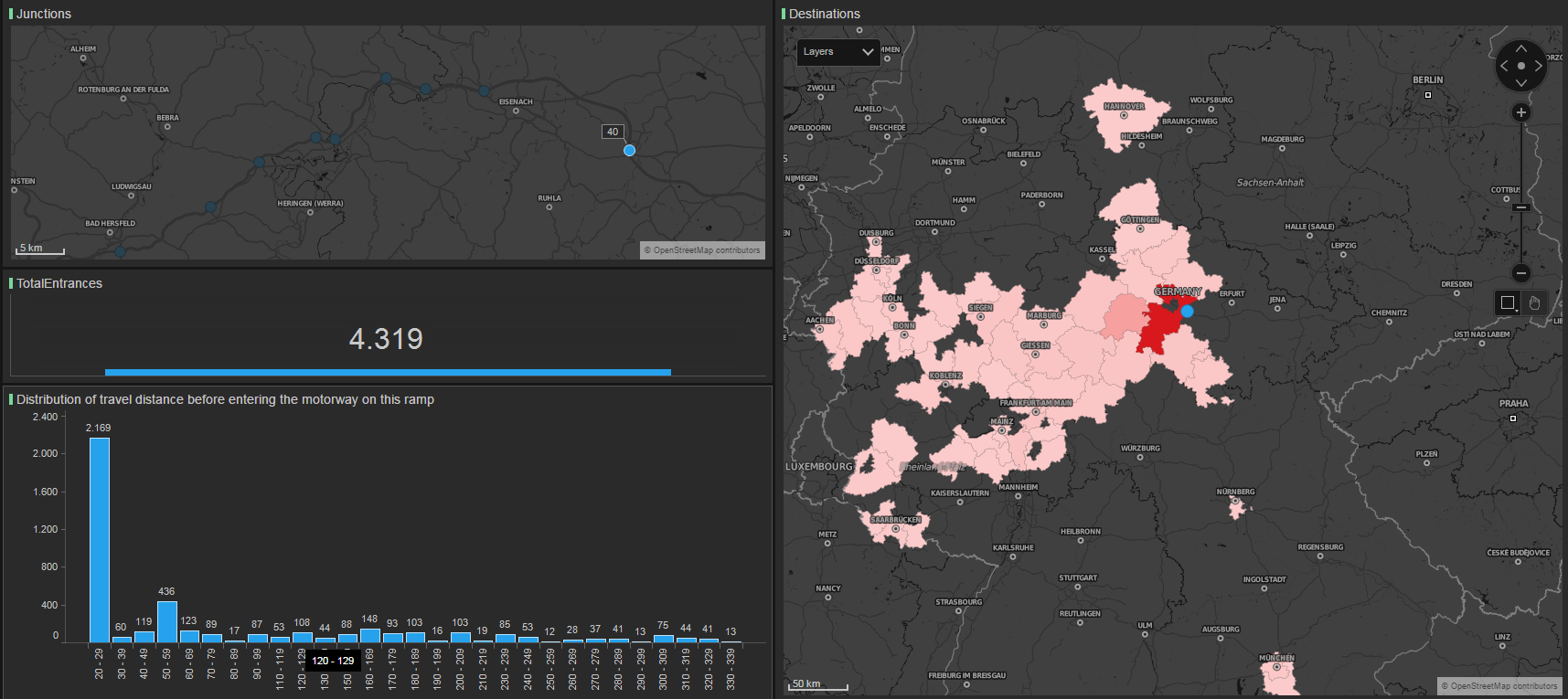
In post processing we filtered out fuzzy relations caused by detours
Via points on junctions
We have manually added unique via nodes on the motorway links into our infrastructure
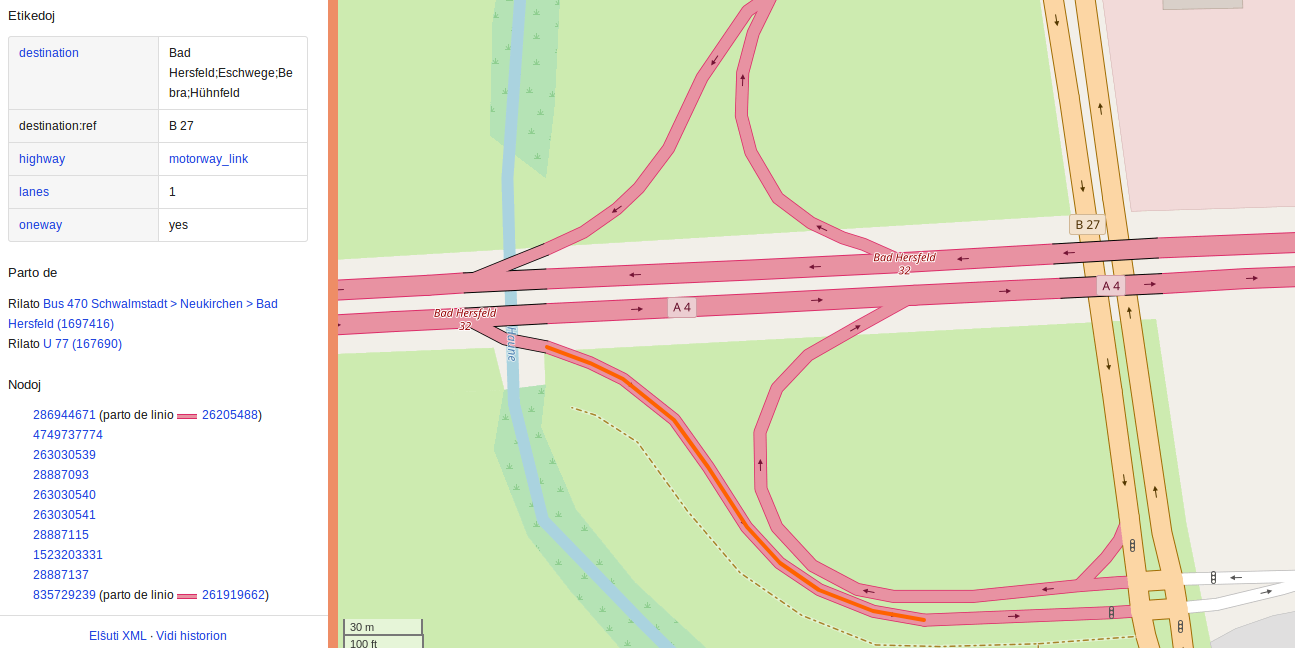
via point on junction
We associate this points to a location and we group entrances and exits together:
 "input_locations":[
      {"location_id":"exit_32",
        "node_list":[263030540, 2675499063]},
      {"location_id":"entry_32",
        "node_list":[227910516, 25418734]},
and created the appropriate qsm job where all nodes are grouped into via locations.
Analyzer
These chains are passed thought the analyzer and we analyze a few trajectories .
At first we spot some strange behaviour:
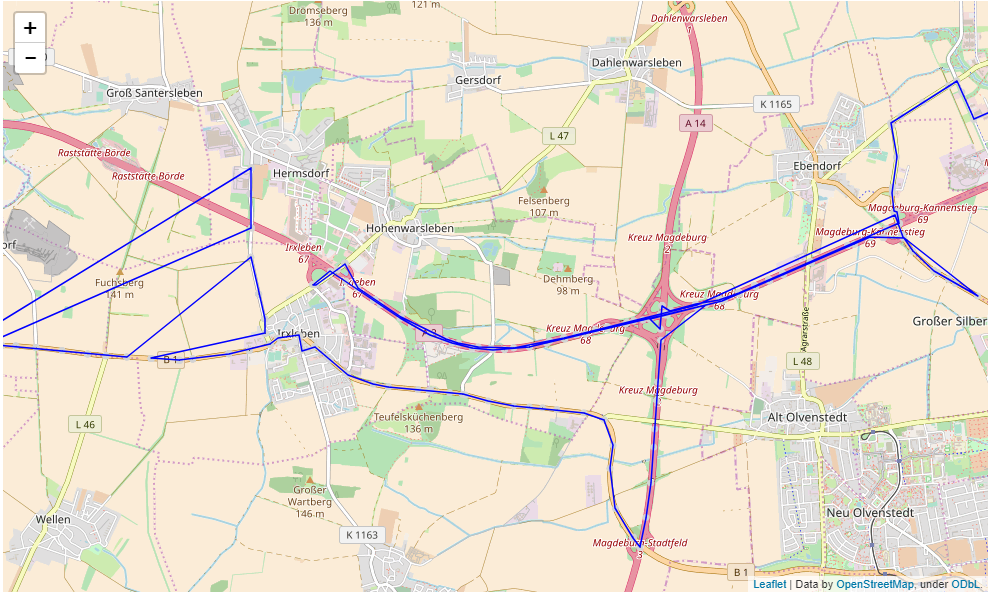
inspection on routing
After the second analyzer run:
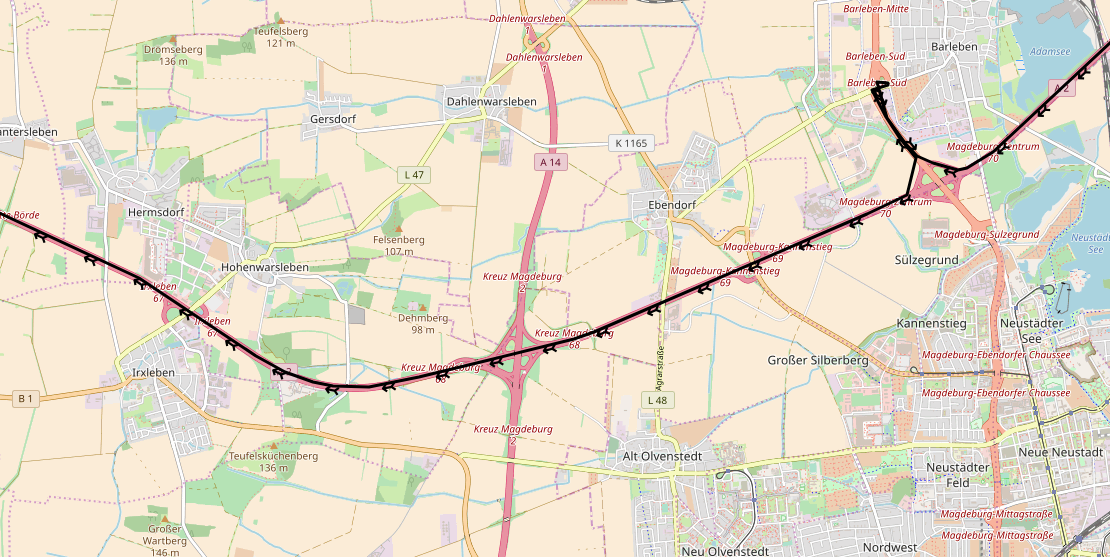
inspection on routing, second run, improved results
Traffic on via nodes
We analyze the number of users passing by entrances and exits and find the relationships between ramps:
via counts
,
traffic on some via nodes
We look at the size of entrances and exits to spot possible asymmetries:

The radius show the size of entrances (blue) and exits (red), circles are pretty symmetric
Pair relationships
We investigated the relationship between
via nodes on the junctions
and we spot some detours that falsify the counts that we are going to correct in postprocessing.
We visualize some relationships using kepler
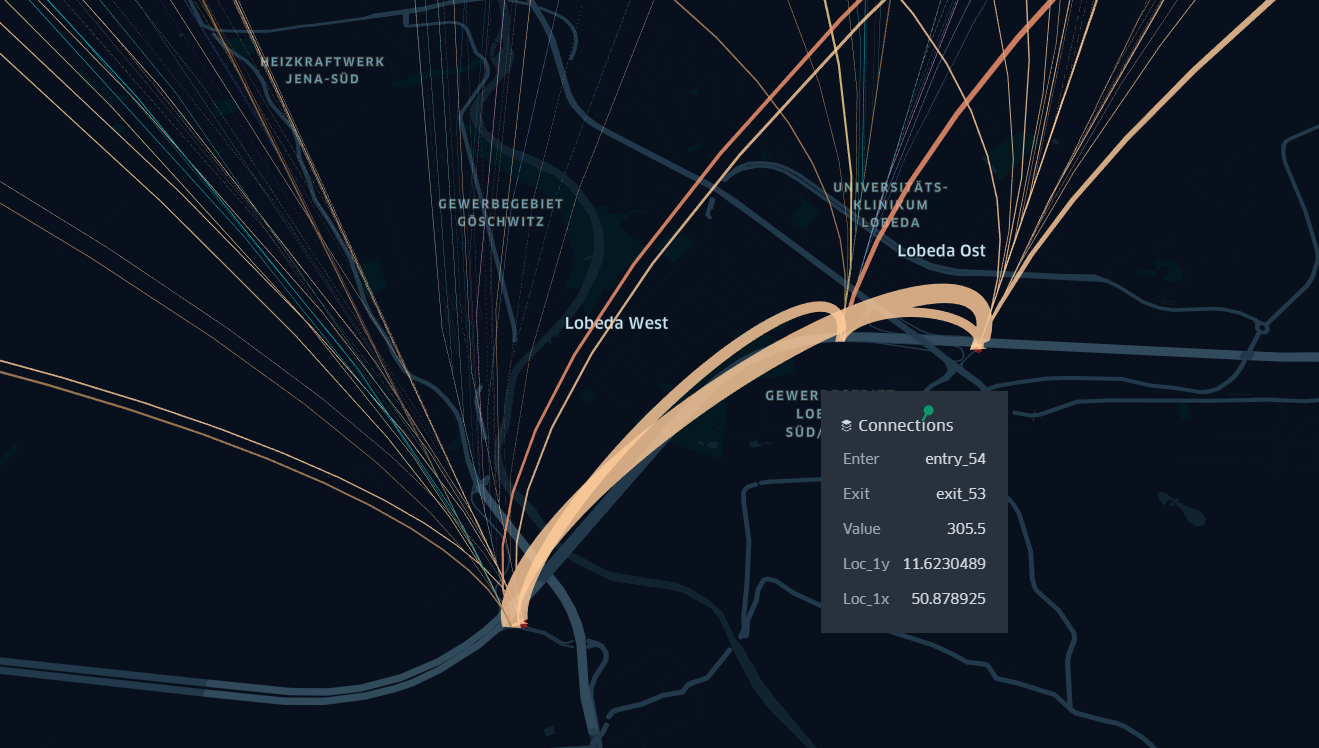
visulization of pair relationships
Postprocessing
We consider the first entrance and the last exit removing all internal loops etl_nissanVia
exit_36;entry_36;exit_41b;entry_42 -> entry_36;exit_41b
exit_34;entry_34;exit_36;entry_40b;exit_41a -> entry_34;exit_41a
This filters out 26% of all trajectories which have no 1st entry and lst exit.
We remove unrealistic routes:
entry_56a;entry_41b
exit_32;exit_42;entry_42
We keep strange routes:
entry_59, exit_61, entry_60, exit_57
In this way we can build a matrix of all the connections between junctions.

We count all the pair connection between junctions, we see how connections get thinner on larger distances
We pivot the table and obtain a square matrix showing all the enter and exit relations:
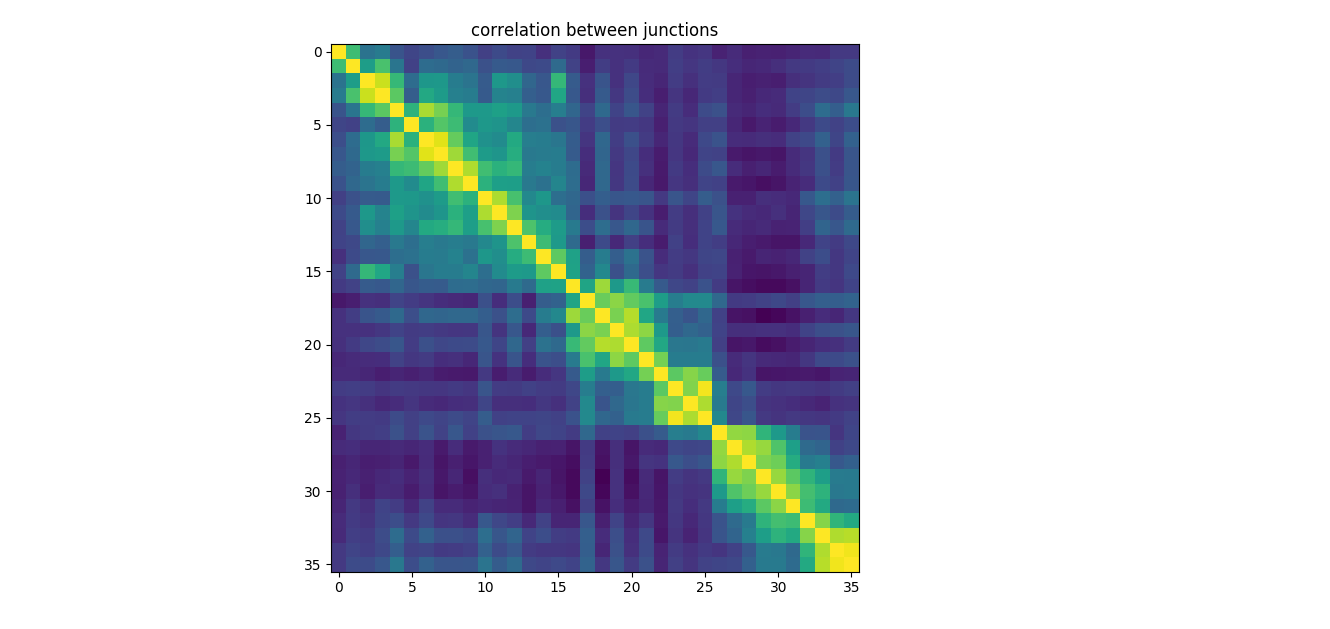
correlation between junctions, neighboring junctions show good correlation, we must investigate the boundaries of the correlation blocks
Junctions distance
To obtain the routed distance between junctions we request an openstreetmap api .
    baseUrl = "https://api.openrouteservice.org/directions?"
    nodeD = []
    for i in range(nodeEn.shape[0]):
        for j in range(i+1,nodeEx.shape[0]):
            g1 = nodeEn.iloc[i]
            g2 = nodeEx.iloc[j]
            print("%s - %s : %.2f%%" % (g1['loc'],g2['loc'],(i*j)/(nodeEn.shape[0]*nodeEx.shape[0])))
            queryS = "api_key=" + cred['openroute']['token']
            queryS += "&coordinates="+str(g1['x'])+"%2C"+str(g1['y'])+"%7C"+str(g2['x'])+"%2C"+str(g2['y'])
All junctions over 150km from a reference junction are labelled as 996 because the current autonomy of the electric car under study is around 160km.
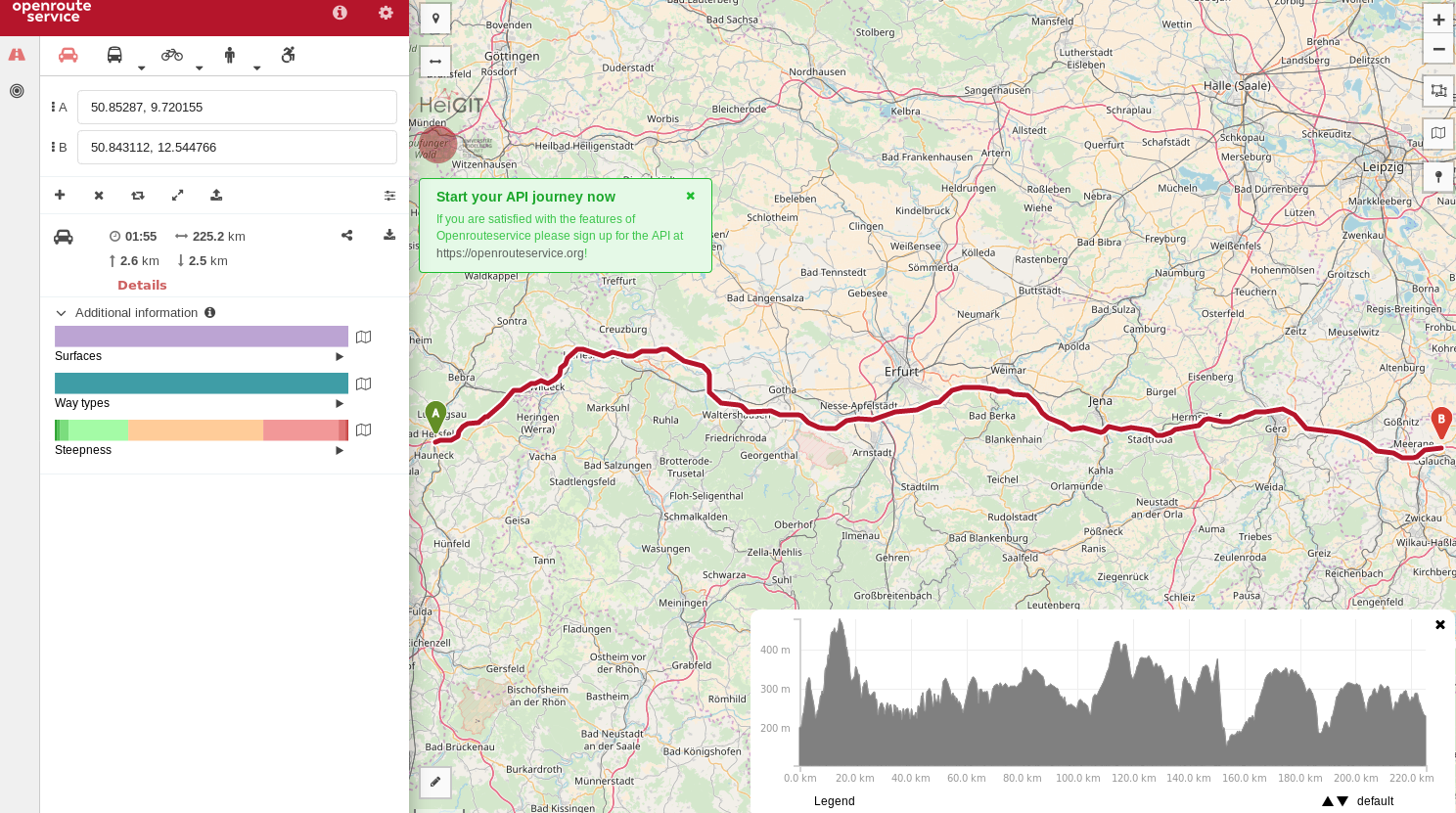
_we use openrouteservice to calculate distances between junctions _
Matrix KPIs
The expected output of the enter2exit matrix should have the expected properties:
- symmetric
- null diagonal
- counts decaying with distance
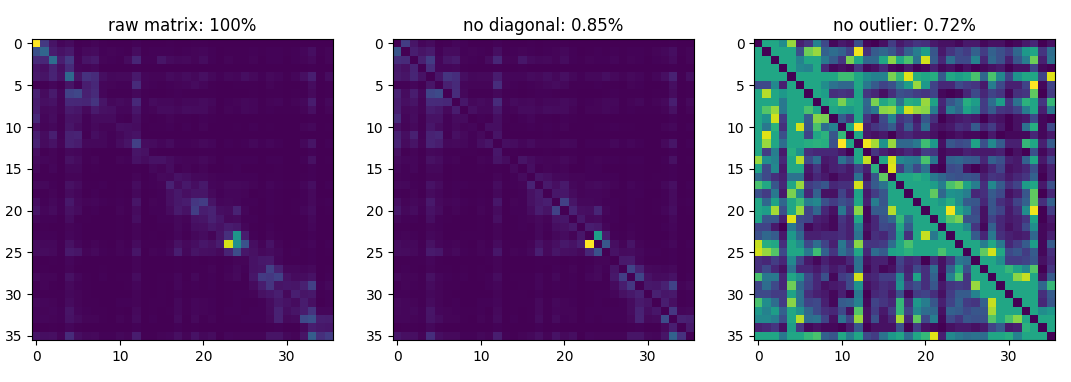
the enter2exit matrix has diagonal counts: 13% and outliers: 5%.
| KPI | single | clamp |
|---|---|---|
| diagonal | 15% | 26% |
| asymmetry | 26% | 21% |
| decay - correlation | -0.3 | -0.4 |
We display the asymmetry matrix coloring all cells under 10% relative difference with green, all cells between 10% and 20% with yellow and over 20% with red.
We have clamped the odd numbered juntions into the even ones.
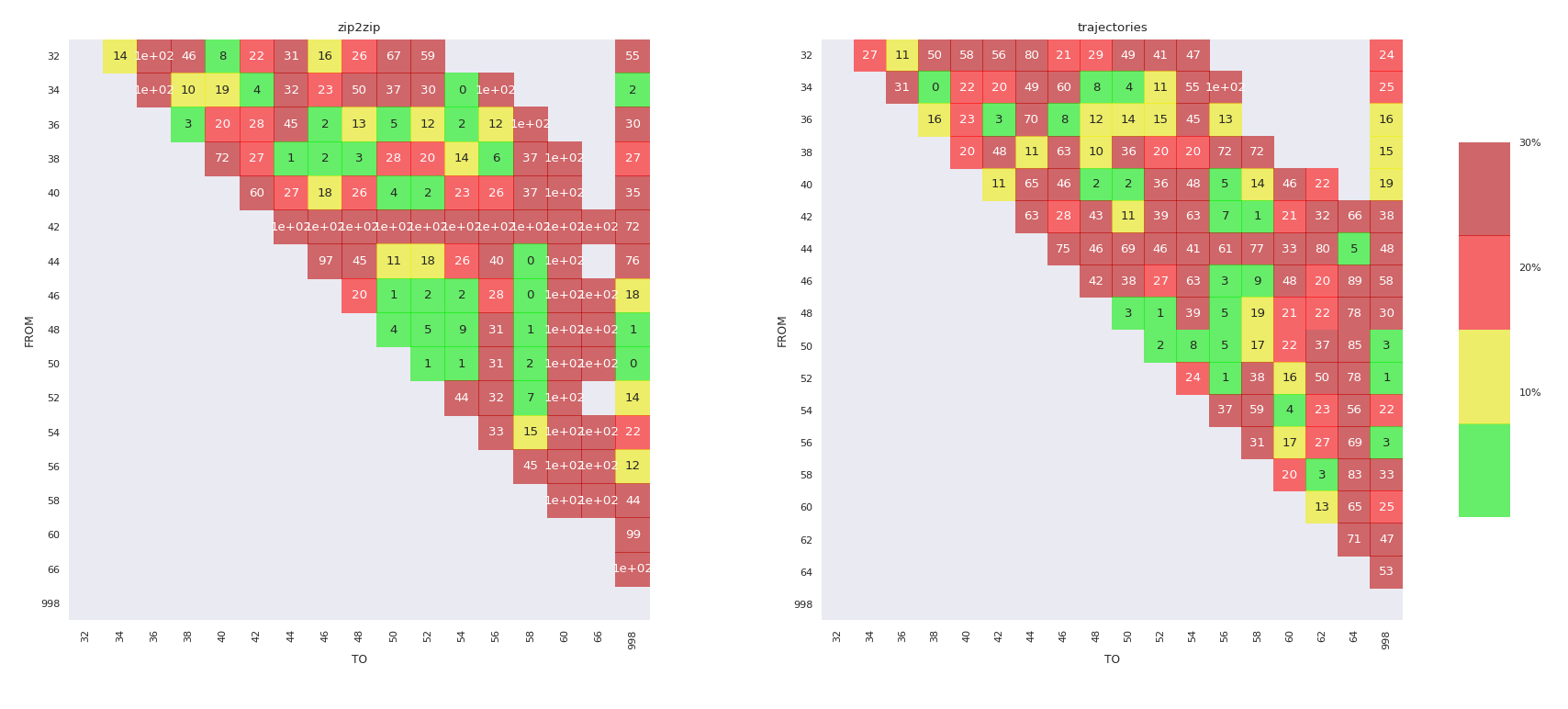
asymmetry matrix with traffic light color code, we compare postprocessing approach (left) with single trajectory sum (right)
$$ \delta = 2\frac{|c_{AB} - c_{BA}|}{c_{AB}+c_{BA}}\cdot w(m_{AB}) $$
where $c_{AB}$ is the number of cars going from A to B
$$ w(m_{AB}) = b + m_{AB}\frac{1 - b}{max(m_{AB})} $$
and $m_{AB}$ is the maximum between $c_{AB}$ and $c_{BA}$ and $w$ is the weighting function and $b$ the intercept.
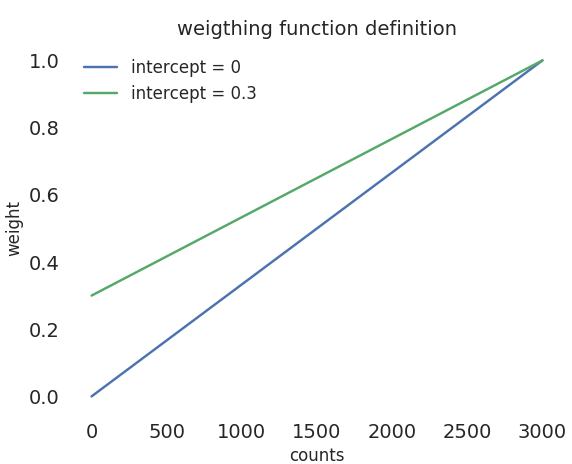
definition of the weighting function
| range | trajectories | zip2zip |
|---|---|---|
| within 10% | 39% | 24% |
| within 20% | 26% | 12% |
| over 20% | 35% | 64% |
We see a small dependency between junction length and number of cars.
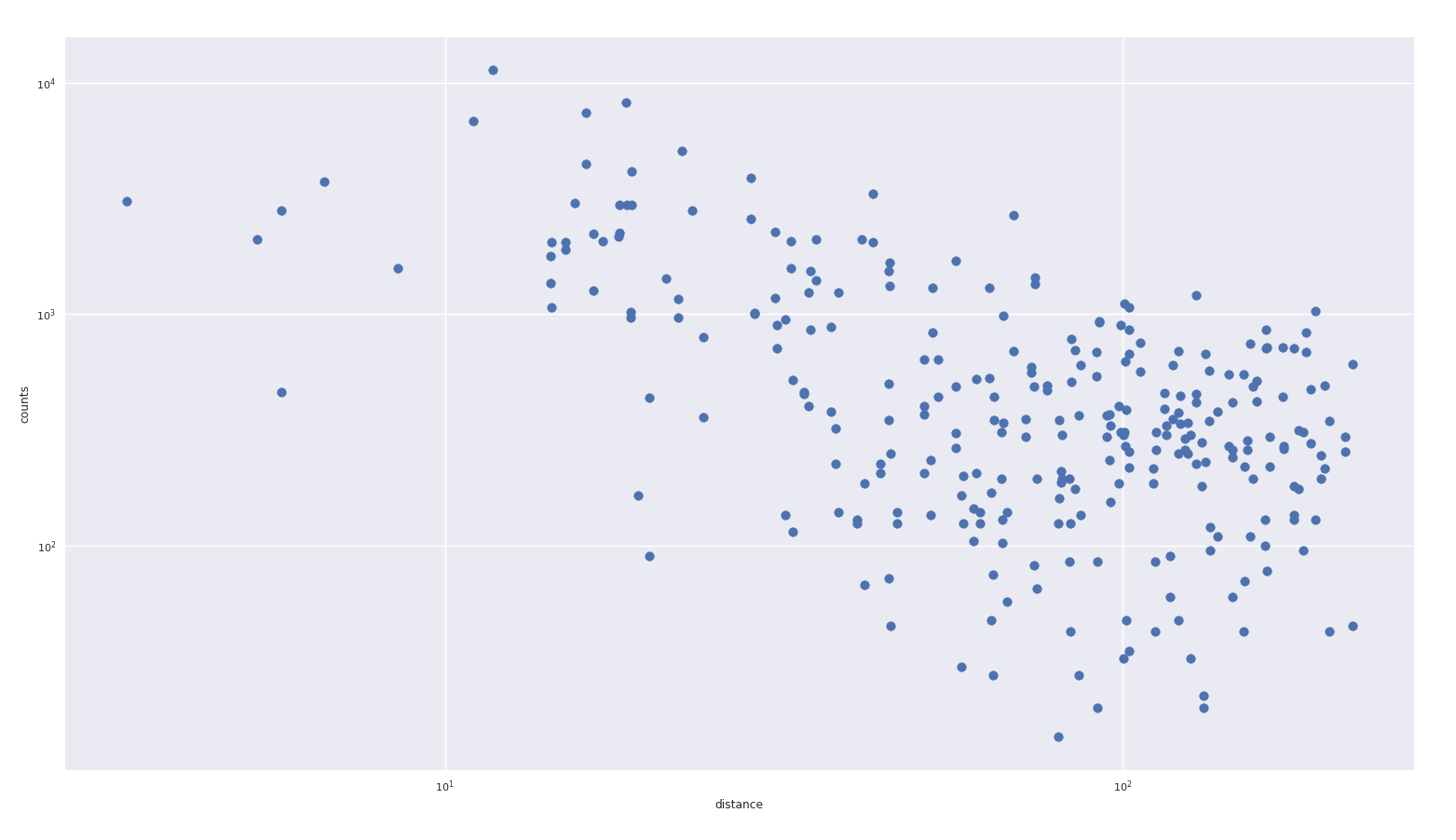
the number of cars decay with junction distance
fixing asymmetry
We have realized that some junctions were particularly asymmetric and we started investigating few trajectories
We saw some trajectories be forced to take the junctions
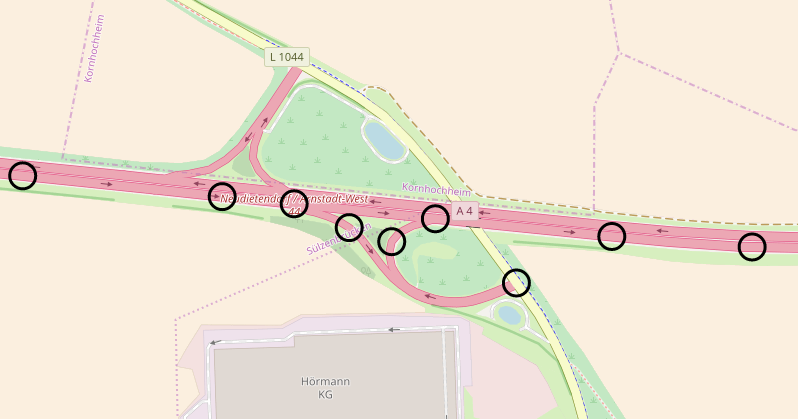
some routes are forced to proceed on the junction
We sorted the timestamps and saw a strange arrangements of nodes.
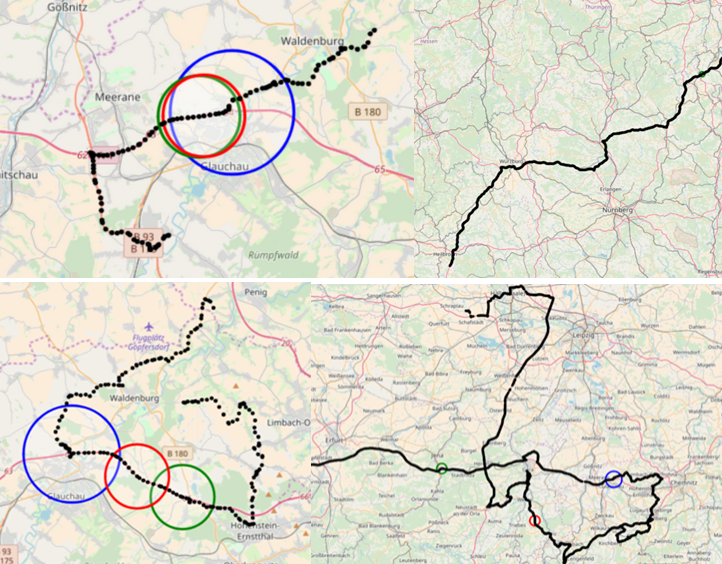
start (green) end (red) and junction (blue) are not conseguent
We saw that an unprecise definition of the starting point led to detours.
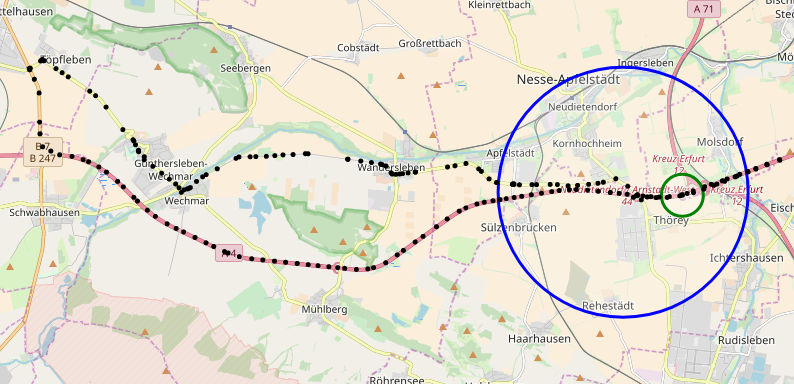
the start node competes with other events that might help to distinguish the real start
B-spline are important to neutralize the swing between cities that are denser in cells which force the trajectory to leave the motorway to approach to a city and go back to continue the trip.
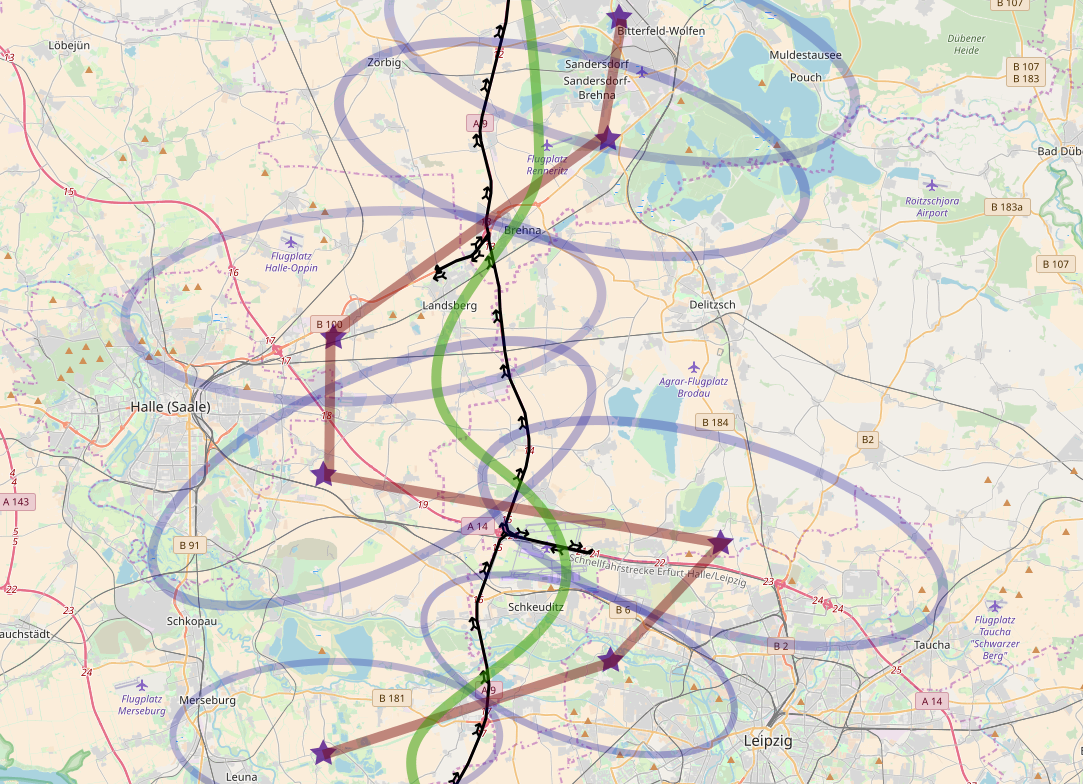
black: routed trajectory, red: events line, stars: hypothetical cell's centroids, ellipses: hypothetical BSEs, crossing the motorway
Topics on router
There are different issues (routing, starting-ending point, graph) from my opinion:
- a trip should not start on a motorway
- direction changes on the motorway shouldn't be allowed
- still many detours
- segments are missing (junctions complete the gaps on motorway stretches)
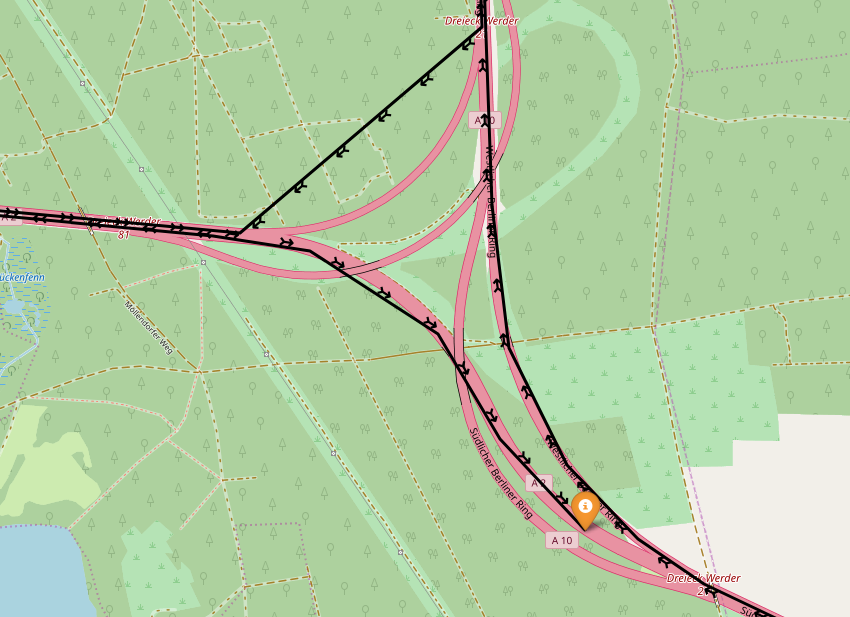
starts and ends on the motorway lead to asymmetry
My suggestion is to update our graph to have a series of parameter which can help the routing:
GRAPH
When we transform the complete OSM node collection into our production graph I would add the following attribute to each segments of graph:
- routed distance: helps the routing weights, more realistic distances
- chirality: chirality change is irrealistic
- gyration radius: helps the routing weights, streight segments should be preferred
START-END
- start-end points should not be on the motorway
- paths should be included between start and end. the events too far away from start-end bounding box should be filtered out
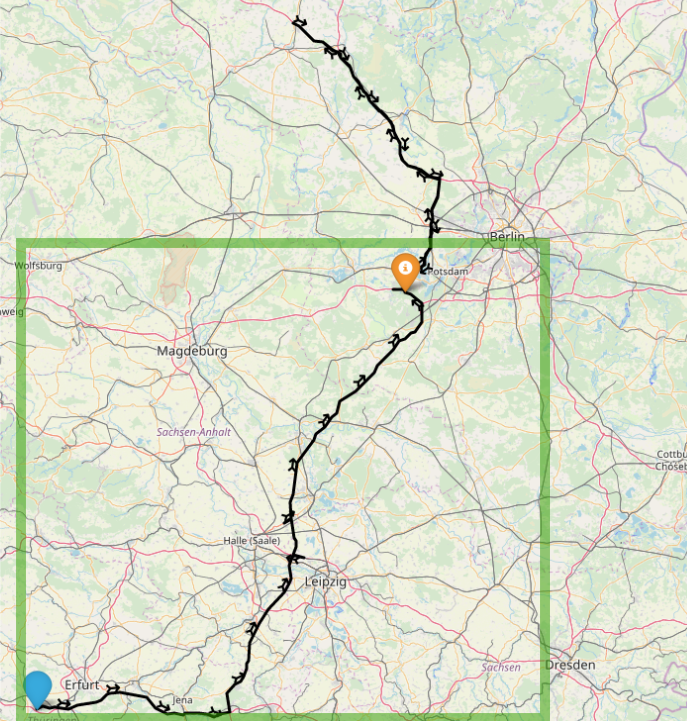
enter and exit bounding box
DETOURS
-
do we smooth the events position before routing (B-splines?)

detours bring to asymmetry
AB routing
To avoid detours we have started using AB routing which drammatically improves the number of loops.
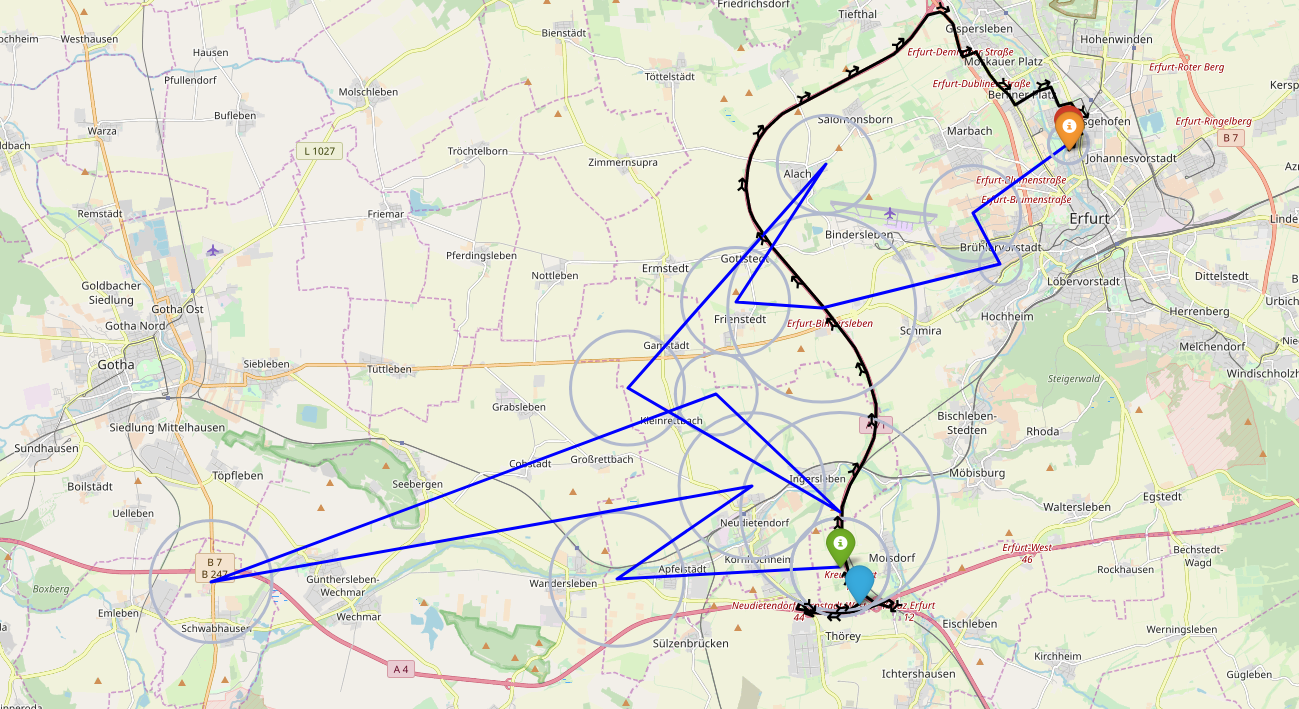
AB routing avoid detours
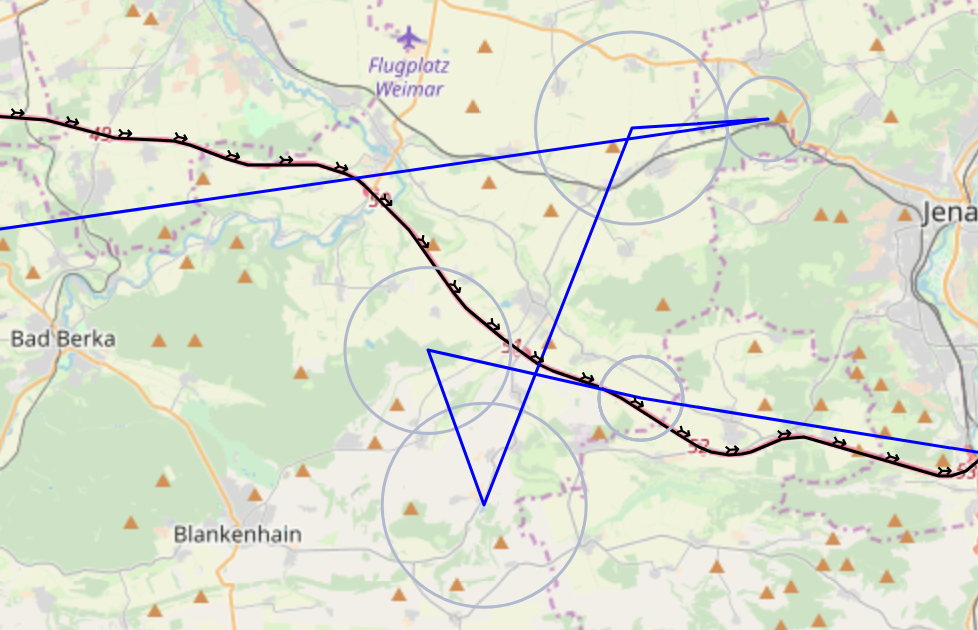
detour avoided discarding neighboring events
Improvements
The series of iterations we did helped improving the precision of the enter2exit relations. The last run consists on a more days sum.
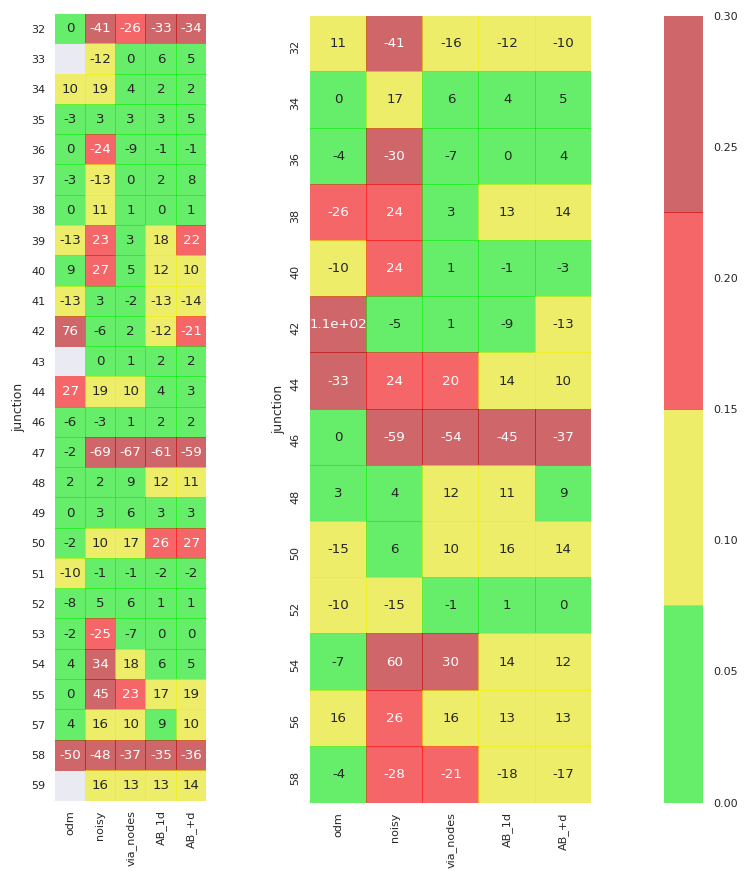
The asymmetry matrix view show how the precision of the asymmetry improved from the first to the last analysis.
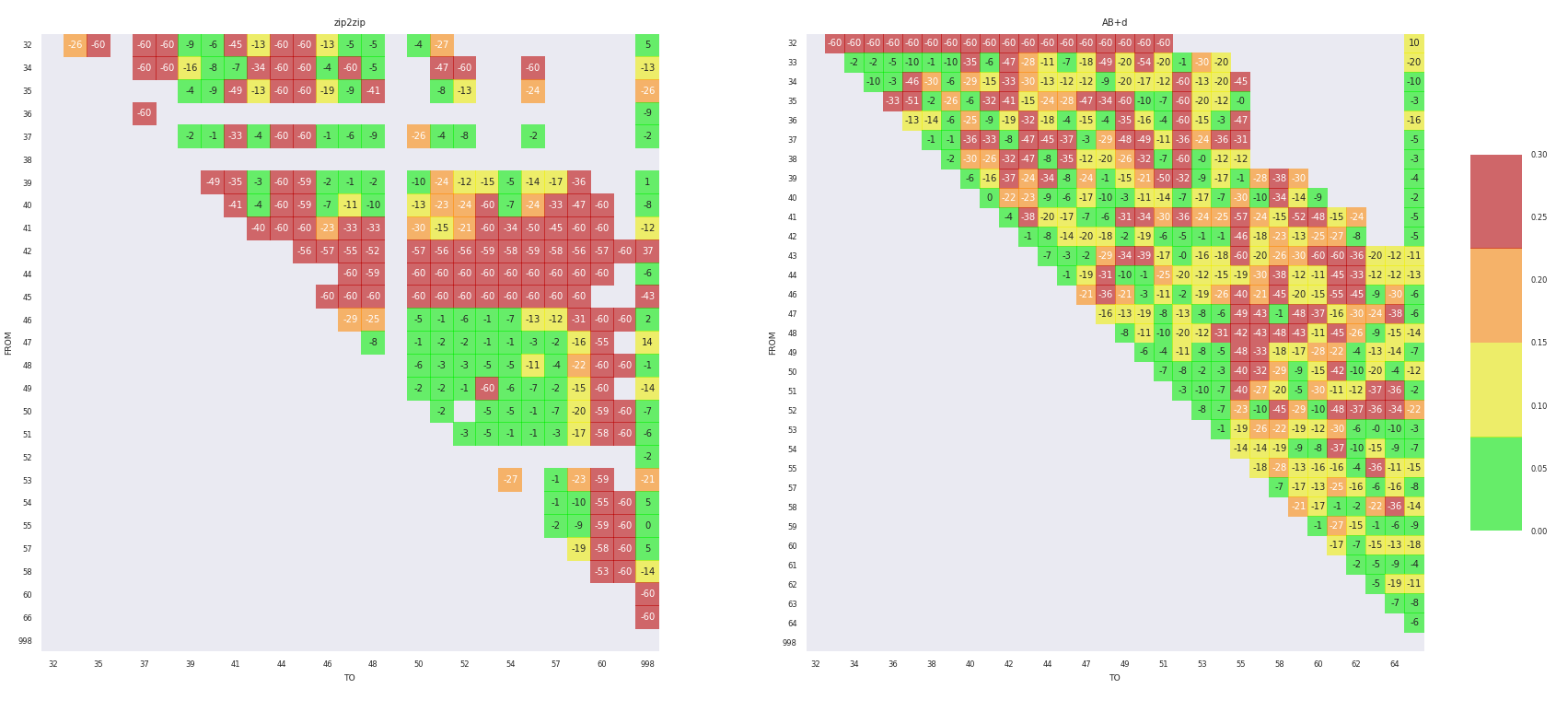
We still can see few problems to solve:
- junction 32 is not correctly mapped in the infrastructure
- junctions 47, 58 show high asymmetry but no particular reason was found
Junction labelling automation
To automize the labelling of the nodes of the junctions we write two functions.
- enrichNissan where we project all nodes on the motorway, calculate the perpendicular distance from the motorway and side of the motorway (via chirality)
-
junctionNodes
we iterate over
id_jun,chi,id_zone, anddirto calculate the local center of mass and the orientation depending on the cross product
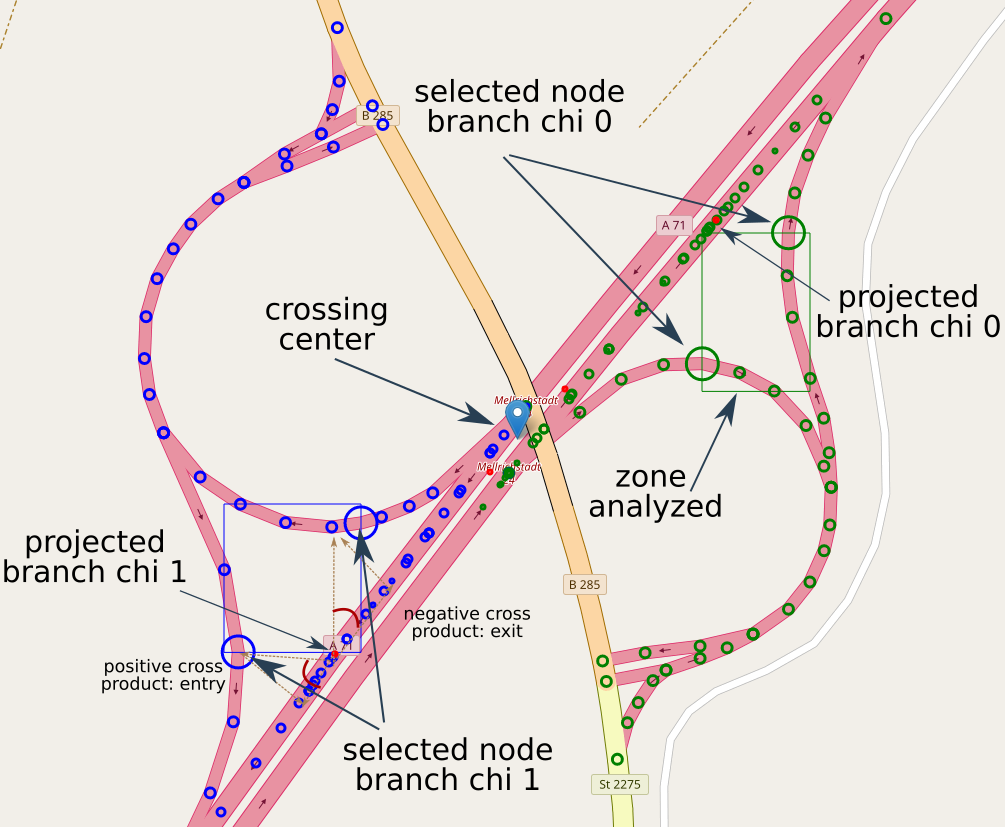
graphical explanation on the selection and identification of nodes works
The algorithm supposes there are two branches per motorway and one entry and one exit per branch. Everything is splitted in 700m cluster to improve the accuracy if the crossing is large enough.
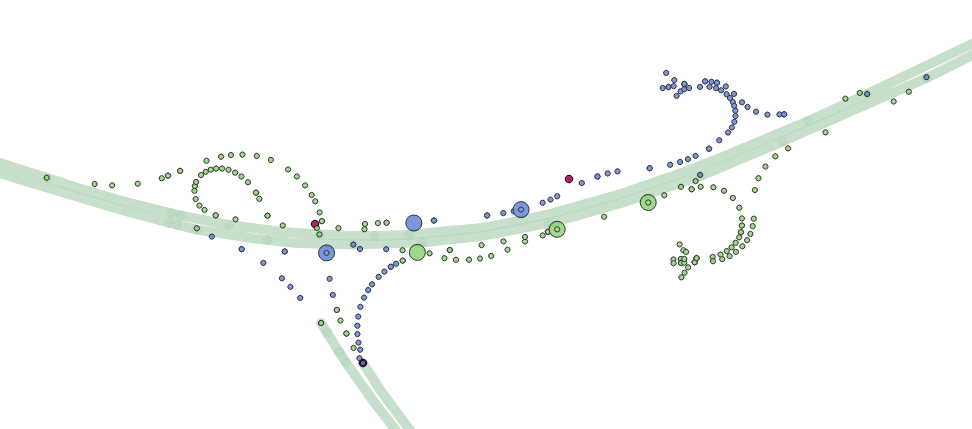
not all topologies can be covered by the algorithm
any via after junction labelling
After have labelled all junction nodes to be included in the infrastructure we run an odm any via for 1M3 chains dataset to obtain the number of trajectory crossing the via points in Thüringen .
We run the kpi calculation based on the results of the data
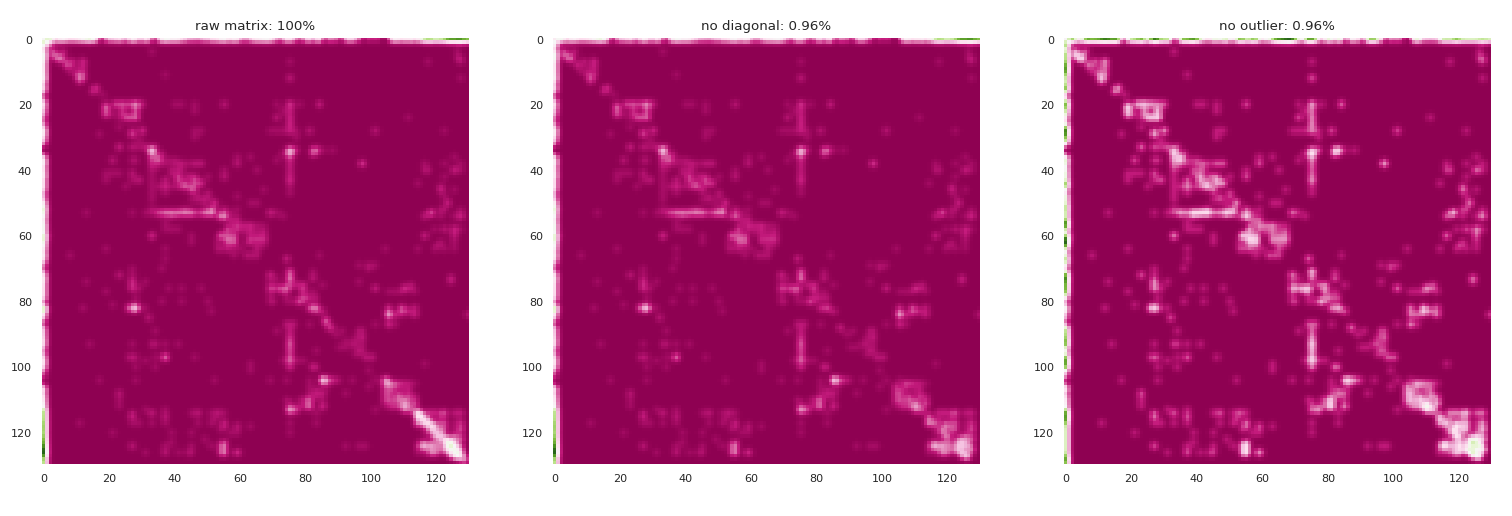
count matrices between entry and exits
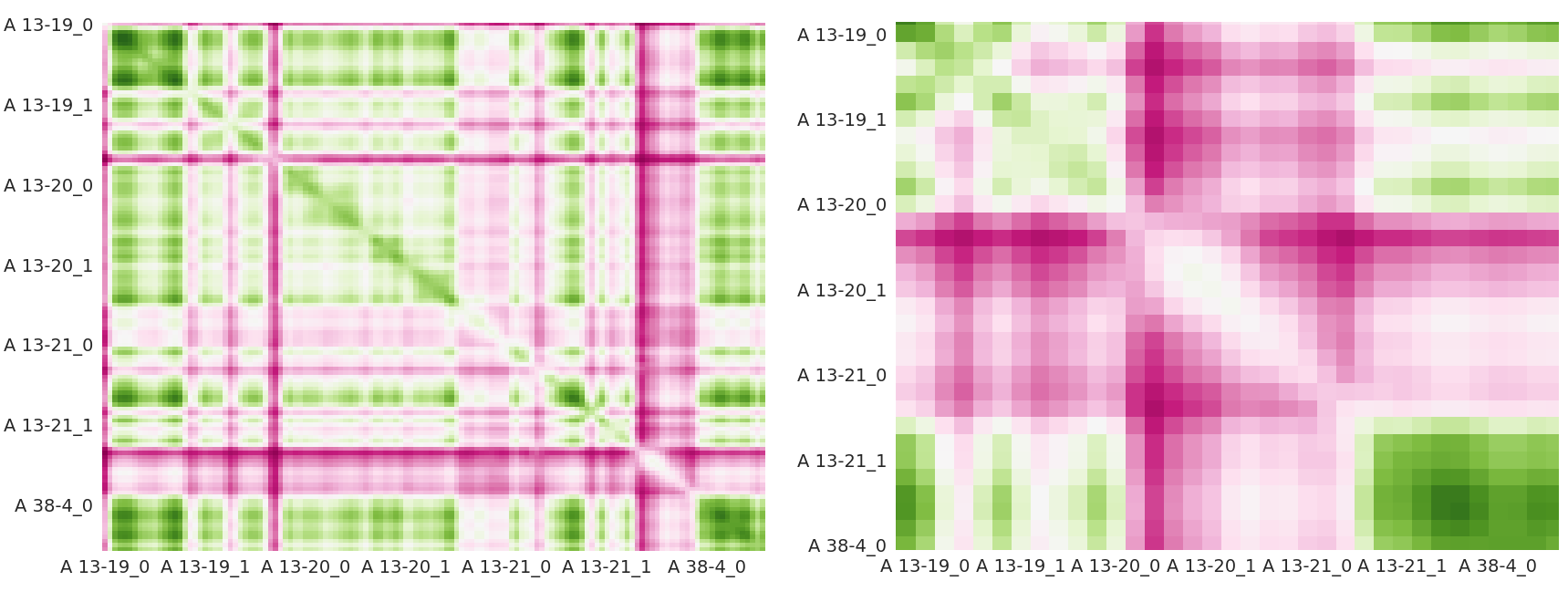
correlation between pair relation counts, on the rhs we magnified the zone with lower correlation
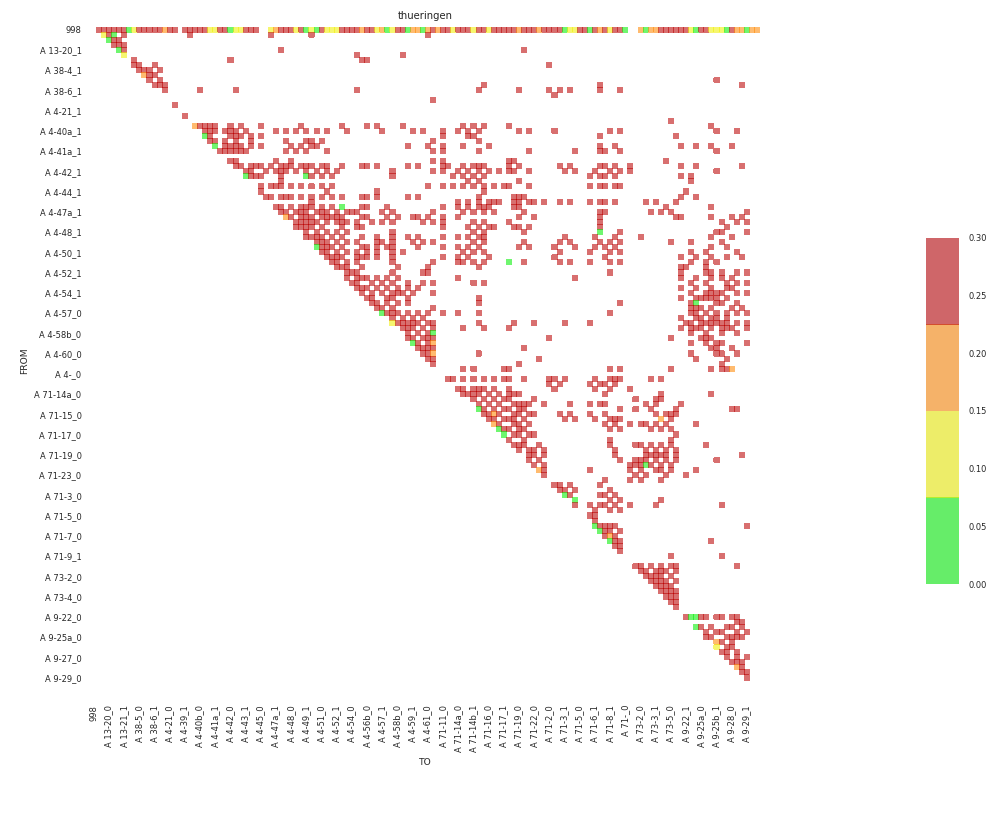
most of the relations show asymmetry but it's due to low counts
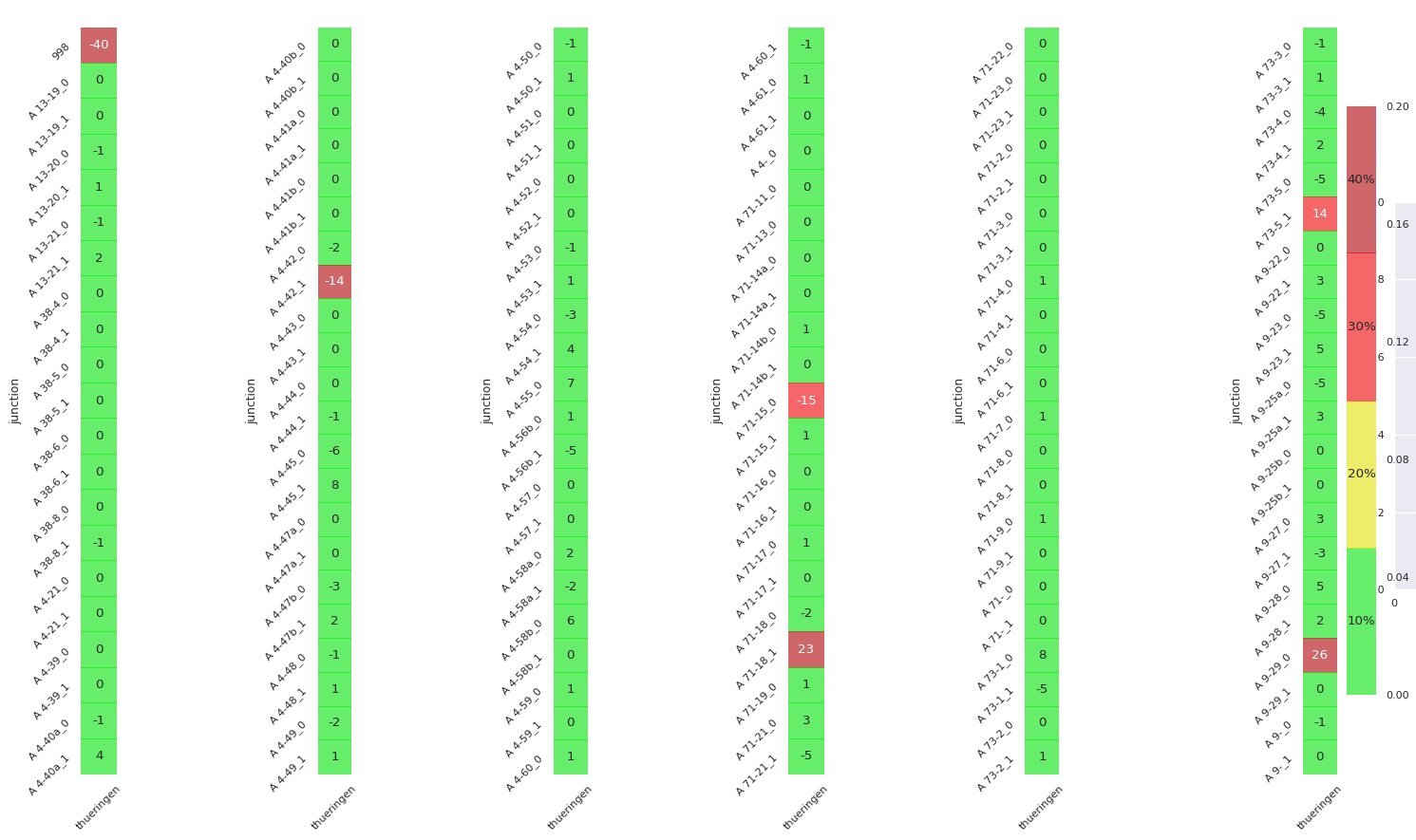
even on junction sum symmetry is not conserved
No clear picture about result performances can be given with this few trajectories.
from trajectories to junction pairs
We perform a further correction of the job file and change the definition of the delooper. We break all the trajectories into single pairs. For every uncomplete entry or exit we associate the junction 998.
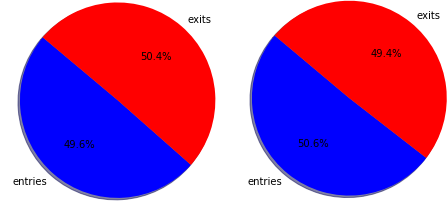
if we count the total number of entrances and exits symmetry is conserved, both for all the any via combinations (lhs) and for the 2 via nodes trajectories (rhs)
We have a fair number of motorway junction crossed during a trajectory in Thüringen. 3 and 4 via node trajectories correspond to shortcuts, U turns and breaks.
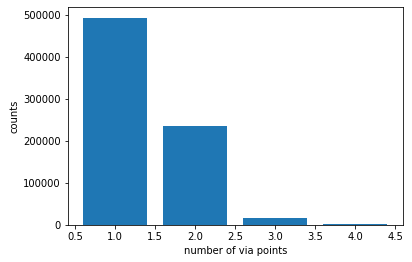
via points pro trajectory
We than see that we still have asymmetries on the single junction level but the total asymmetry is conserved
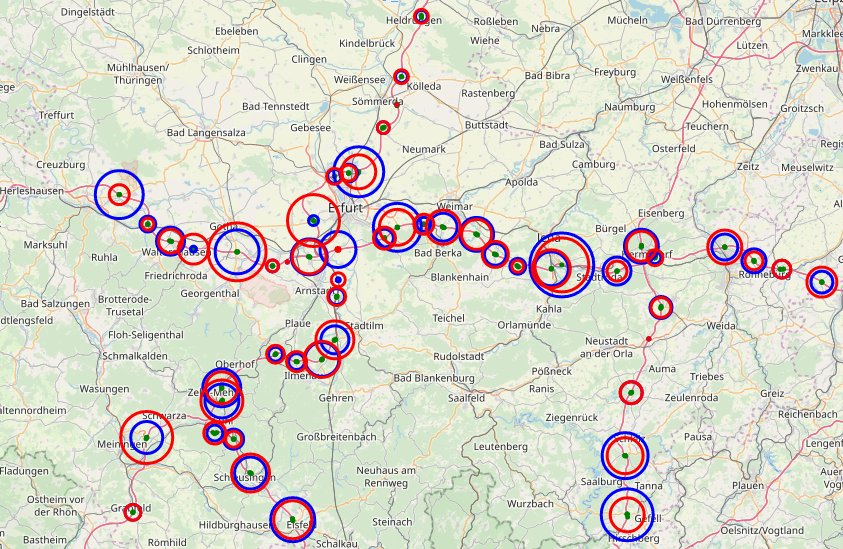
counts of entries (blue) and exits (red) pro junction