Spiega documentation
- Knowledge sharing
- Portfolio
Deep learning concepts
A neural network are layers of neurons connected by activation functions that transform an input into an output. In between there are different hidden layers which build the logic between input and outputs. The prediction is evaluated via a score function whose result is used to build an optimizer that backpropagates along the network to update neurons weights and minimize the consecutive error.
To avoid biases data is split into train, test and validate blocks. The train test is the one used to compute the networks weights, the validation set is used to compute the unbiased score of the model and to tune hyperparamenters, the test set is used to asses the final score of the model since this data hasen't been used before.
feed forward
The flow of information is in the forward direction, supervised without feedback.
We take a matrix $X$ on $nxm$ dimensions and a prediction variable $y$ of $k$ elements.
We select a weight vector $w_1$ with $l_1$ entries and a ReLU function $g_1: \mathbb{R}^l \to \mathbb{R}^l $ so that
$$ (g_1(y)) = max{y_i,0} \qquad z_1 = g_1(w_1\beta + b) $$
The second and third layers have:
$$ z_2 = g_2(w_2 z_1 + b_2) \qquad z_3 = g_3(w_3 z_2 + b_3) $$
and finally the predicted variable:
$$ \hat y_i = softmax_i(z_3) = \frac{e^{(z_3)_i}}{\sum_j e^{(z_3)_i}} $$
We have therefore to set the parameters: ${w_1, w_2, w_3, b_1, b_2, b_3}$
layers
Usually layers used in a network are:
- input: data formatted in tensors
- normalization: predetermined min/max to scale values between [0,1] or [-1,1]
- convolutional: applies NxN filters across NxN neurons around each selected neuron
- pooling: decrease sensitivity to features (usually averaging or taking the max over patches)
- activation: applies activation functions
- dropout: nullify some weights to decrease parameter space
- output: prediction formatted as a tensor
dense - flatten
Flatten From matrix to array
dense(16) + input(5,3) = output(5,16)
input(5,3) + flatten() = input(15) + dense(16) = output(16)
batch
The total number of examples in a training iteration
activation functions
Activation functions are used to connect neurons between networks. Usually the activation functions is constant througout the hidden layer and might vary at the output layer. The main reason to select an activation function for the output layer is the domain of the output variable:
- binary classification: sigmoid
- multiclass: softmax
- multilabel: sigmoid
A key feature for the activation function is derivability since backpropagation requires at least the first derivate of the function.
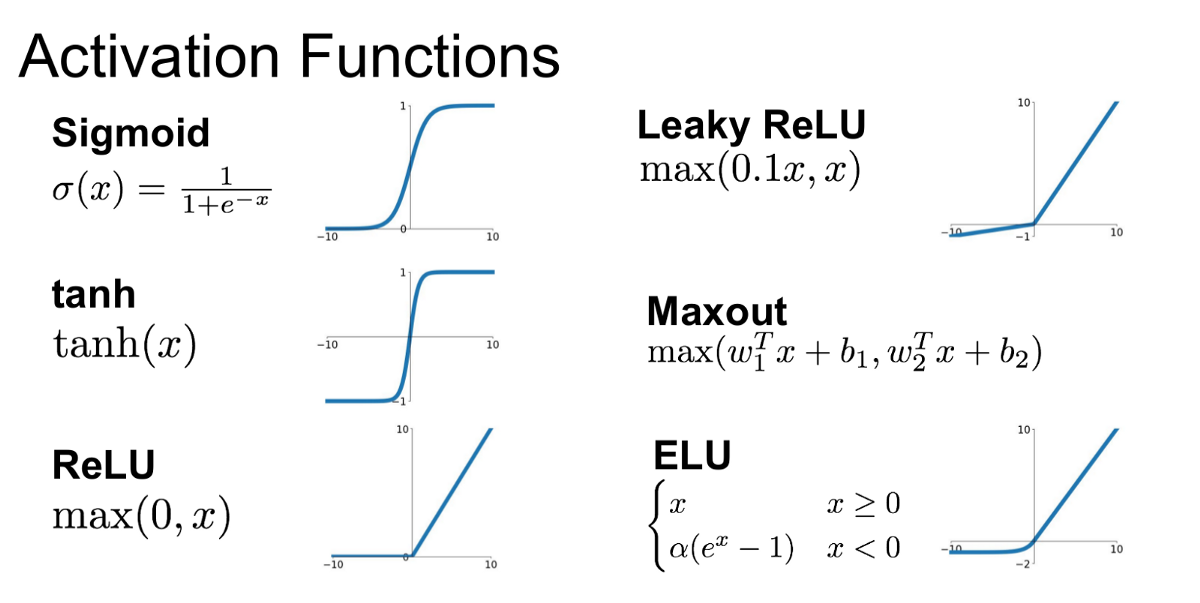
list of activation functions
Sigmoid / Logistic
Advantages
Smooth gradient, preventing “jumps” in output values.
Output values bound between 0 and 1, normalizing the output of each neuron.
Clear predictions—For X above 2 or below -2, tends to bring the Y value (the prediction) to the edge of the curve, very close to 1 or 0. This enables clear predictions.
Disadvantages
Vanishing gradient—for very high or very low values of X, there is almost no change to the prediction, causing a vanishing gradient problem. This can result in the network refusing to learn further, or being too slow to reach an accurate prediction.
Outputs not zero centered.
Computationally expensive
TanH / Hyperbolic Tangent
Advantages
Zero centered—making it easier to model inputs that have strongly negative, neutral, and strongly positive values.
Otherwise like the Sigmoid function.
Disadvantages
Like the Sigmoid function
ReLU (Rectified Linear Unit)
Advantages
Computationally efficient—allows the network to converge very quickly
Non-linear—although it looks like a linear function, ReLU has a derivative function and allows for backpropagation
Disadvantages
The Dying ReLU problem—when inputs approach zero, or are negative, the gradient of the function becomes zero, the network cannot perform backpropagation and cannot learn.
Leaky ReLU
Advantages
Prevents dying ReLU problem—this variation of ReLU has a small positive slope in the negative area, so it does enable backpropagation, even for negative input values
Otherwise like ReLU
Disadvantages
Results not consistent—leaky ReLU does not provide consistent predictions for negative input values.
Parametric ReLU
Advantages
Allows the negative slope to be learned—unlike leaky ReLU, this function provides the slope of the negative part of the function as an argument. It is, therefore, possible to perform backpropagation and learn the most appropriate value of α.
Otherwise like ReLU
Disadvantages
May perform differently for different problems.
Softmax
$$e^x/sum(e^x)$$ which resemples Boltzmann probability
Advantages
Able to handle multiple classes only one class in other activation functions—normalizes the outputs for each class between 0 and 1, and divides by their sum, giving the probability of the input value being in a specific class.
Useful for output neurons—typically Softmax is used only for the output layer, for neural networks that need to classify inputs into multiple categories.
Swish
Swish is a new, self-gated activation function discovered by researchers at Google. According to their paper, it performs better than ReLU with a similar level of computational efficiency. In experiments on ImageNet with identical models running ReLU and Swish, the new function achieved top -1 classification accuracy 0.6-0.9% higher.
cost function
A function that evaluates the error between the fit function and the variable to predict
Squared error (regressions)
$$ F(x,y) = \sum_i (y_i - w_i x)^2 / N $$
Logistic function
$$ F(x,y) = \sum_i log(1 + e^{-y_i(w_i^T x+b_i)} )$$
cross entropy loss (regressions)
Gini impurity
Hinge loss (support vector machine)
Exponential loss (ada boost)
scores
To evaluate the quality of a model different scores are use to evaluate the predicitons
- Classification Accuracy: percentage of corrected predictions (diagonal elements in the confusion matrix)
- sensitivity: TP/(FN+TP), specificity: TN/(TN+FP)
- precision: TP/(TP+FP), recall: TP/(TP+FN)
- F1 Score: 2/(1/precision+1/recall)
- Logarithmic Loss: $$\frac{1}{N}\sum_i\sum_j y_{ij} \log(p_{ij}) $$
- Area under Curve: The integral of the area between TP and FP
- Mean Absolute Error: $$\frac{1}{N}\sum_i |\hat{y} - y_i| $$
- Mean Squared Error: $$\frac{1}{N}\sum_i (\hat{y} - y_i)^2 $$
- language models: rouge score
backpropagation
Backpropagation is when after running a prediction the error/cost is evaluated. The cost function is derived using an optimizer which runs trhough the neurons of the network changing the neurons weights to minimize the next iteration error.
optimizer
The optimizer suggests the direction for the minimization of the cost function
$$ min_x F(x) := \sum_i f_i(x) $$
Minimize the cost function $f(x,y)$, first order optimizers use the gradient, the second the Hessian.
- gradient
- first derivative of the cost function
-
move the parameters a step towards the steepest descent with a momentum $\eta$
$$ \eta \gradient F(x) $$ -
Hessian
$$ H^2 := \sum_{j} \gradient f_{ij} (x_j) \gradient f_{ij} (x_j)^T $$ -
Preconditioner
$$ B := diag H $$ -
gradient descent
-
gradient on a random point
$$ x_{t+1} = x_t - \eta \gradient F(x_i) $$ -
stochastic gradient descent
-
gradient on a random batch
$$ x_{t+1} = x_t - \eta_t \gradient f(x_i) $$ - better performances after some step threshold, more stable
-
independent on $\eta$
$$ x_{x+1} = x_t - \eta B_t^{-1} \gradient f_i (x_t) $$
bias/variance
Models can have good scores but the solver might be still too inaccurate for the complexity of the problem (over-simplifying over-complicating). The two cases are:
- bias (underfitting): we introduce a pnality bias in the loss to get less significance on the feature
- variance (overfitting): a pure variance optimization leads to complex solutions
The usual practice is to adapt the number of parameters to the complexity of the problem but there are other regularisation techniques to use.
We can use the weight decay where the square of the weights are considered in the loss function.
We can use dropouts which deactives a portion of the neurons to let the optimizer practically modify the architecture.
feature regularisation
Regularisation adds penality to model complexity to decrease overfitting problems.
The main types of regularizations are:
- L1: lasso regularisation (absolute value)
- L2: ridge regularisation (mean squared value)
- Elastic net: combines L1 and L2
- prune: remove branches of trees
L1: $$ \sum_i(y_i-\sum_j x_{ij}\beta_j)^2 + \lambda \sum_j|\beta_j| $$
L2: $$ \sum_i(y_i-\sum_j x_{ij}\beta_j)^2 + \lambda \sum_j\beta_j^2 $$
L1 is shrinks the least important features to zero and it's suited for feature selection. $$\lambda$$ is an hyperparameter to tune. L1 gradient is independent of parameters and therefore their weight can vanish.
Ridge regression is useful when there are few data points compared to features and helps in reducing feature significance.
dropout
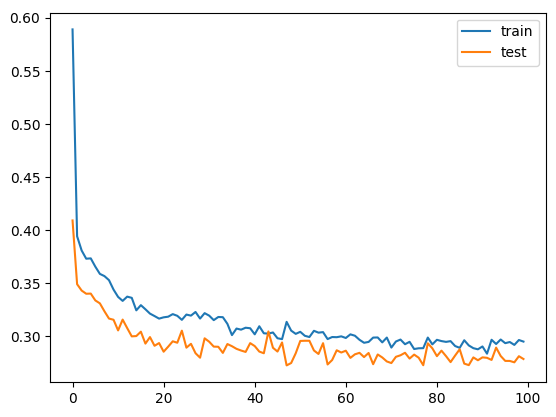
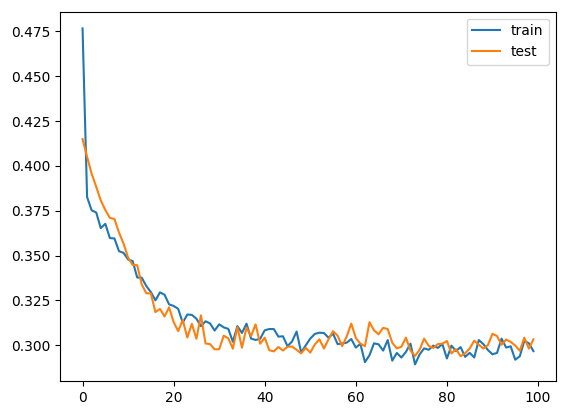
Cuts connections when the weight is low, helps against overfitting.
Binary classification
Not performant, dropout 20:
Just about right, dropout 30:
Overfitting, dropout 50:

data augmentation
Some models and algorithms are useful to increase the dataset for extended training purposes data augmentation .
A classical example concerning computer vision is to iterate all available images and make copies after rotation, subset, filtering of those to increase the cases of non-standard takes.
batch normalization
During training batches can be normalized in case a sampling of the dataset can create big distortions in the distribution of min/max values. More on batch normalization
GAN
A separated article on GANs showing how the adversarial architecture helps creating realistic fakes and some keras implementations.
transformers
Transformes use an encode-decode architecture to reduce the input parameter space. The most significant change compared to previous architectures are the attention layers and the enhanced emmbeddings.