Spiega documentation
- Knowledge sharing
- Portfolio
Antani
Ant - agent/network intelligence
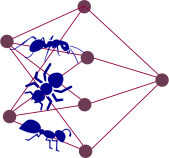
ants optimizing paths on a network
Efficiency
Why operation efficiency?
- Fill the gap between revenue and cost
- Think as a network, not single operator
- Select the most valuable tasks
Problem
The closest path facing the warehouse fullfilling the most valuables tasks

optimization engine requirements
- Focus on profitability
- Plan shifts
- Consider task time and revenue
Commercial softwares?
Delivery based, routific:
* Long deviations
* Skipped tasks
* Unclear priorities
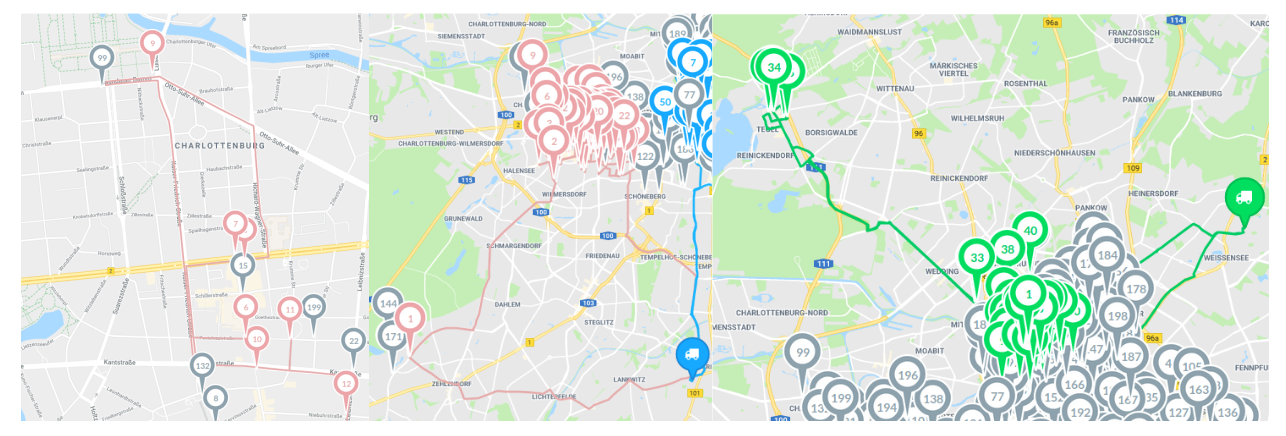
problems with routific
No resuming, everytime a new simulation
Google or-tools?
open source software suite for optimization
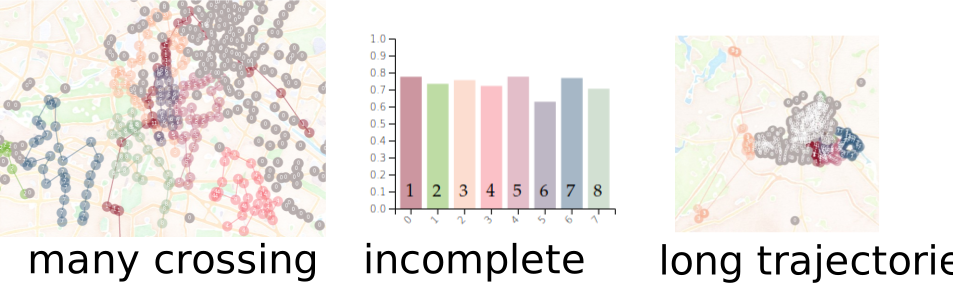
or-tools solutions
Many crossing Incomplete vans, long trajectories:
- incomplete solution (-20%)
- job to be killed
- 0.5-75mins
In house solution
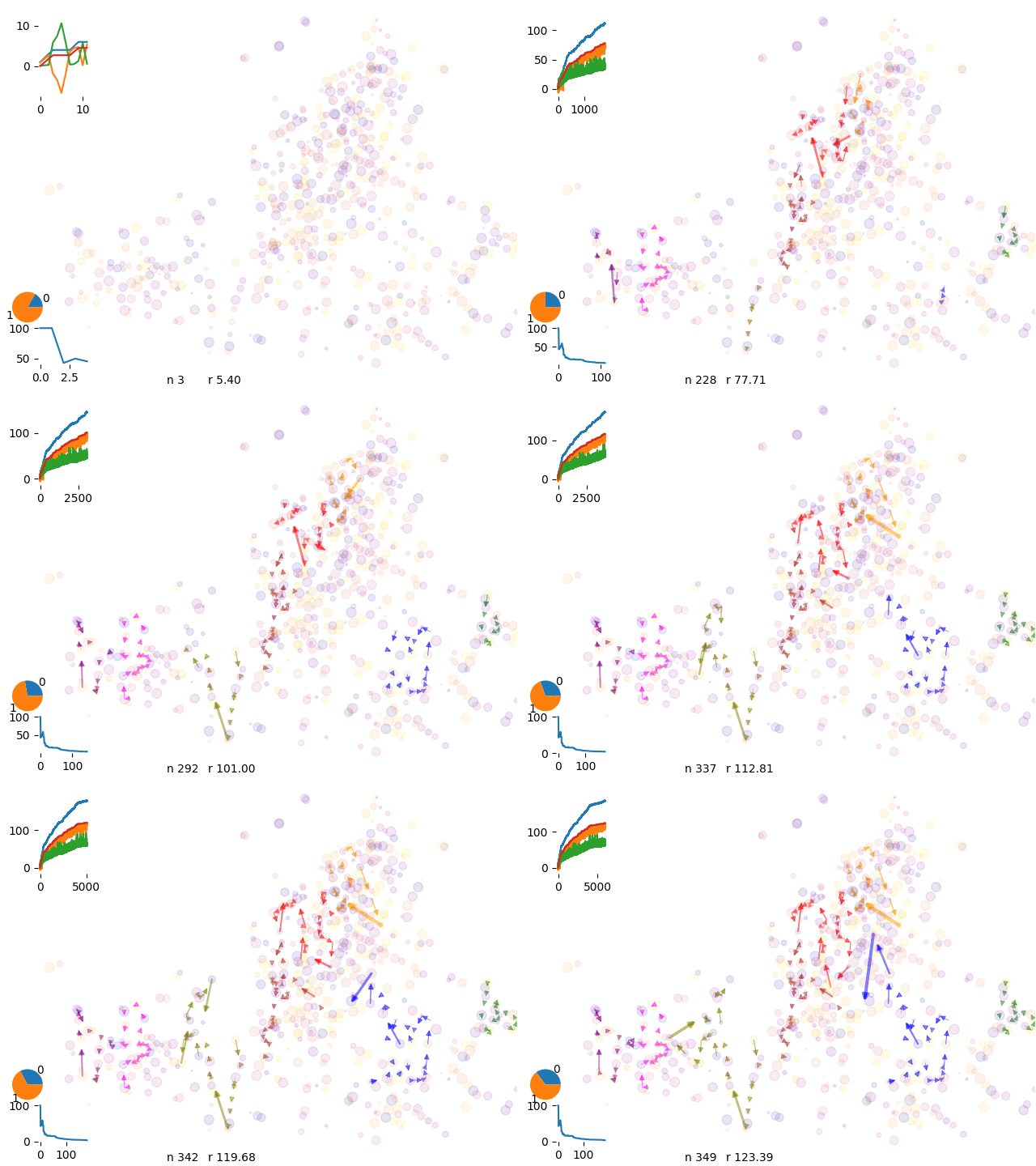
in house optimization engine
Step by step task assignement
Path optimization
Path like polymers

PhD defense – computational biophysics 2012
Optimization engine
Ludewa/Tanzania - 2013
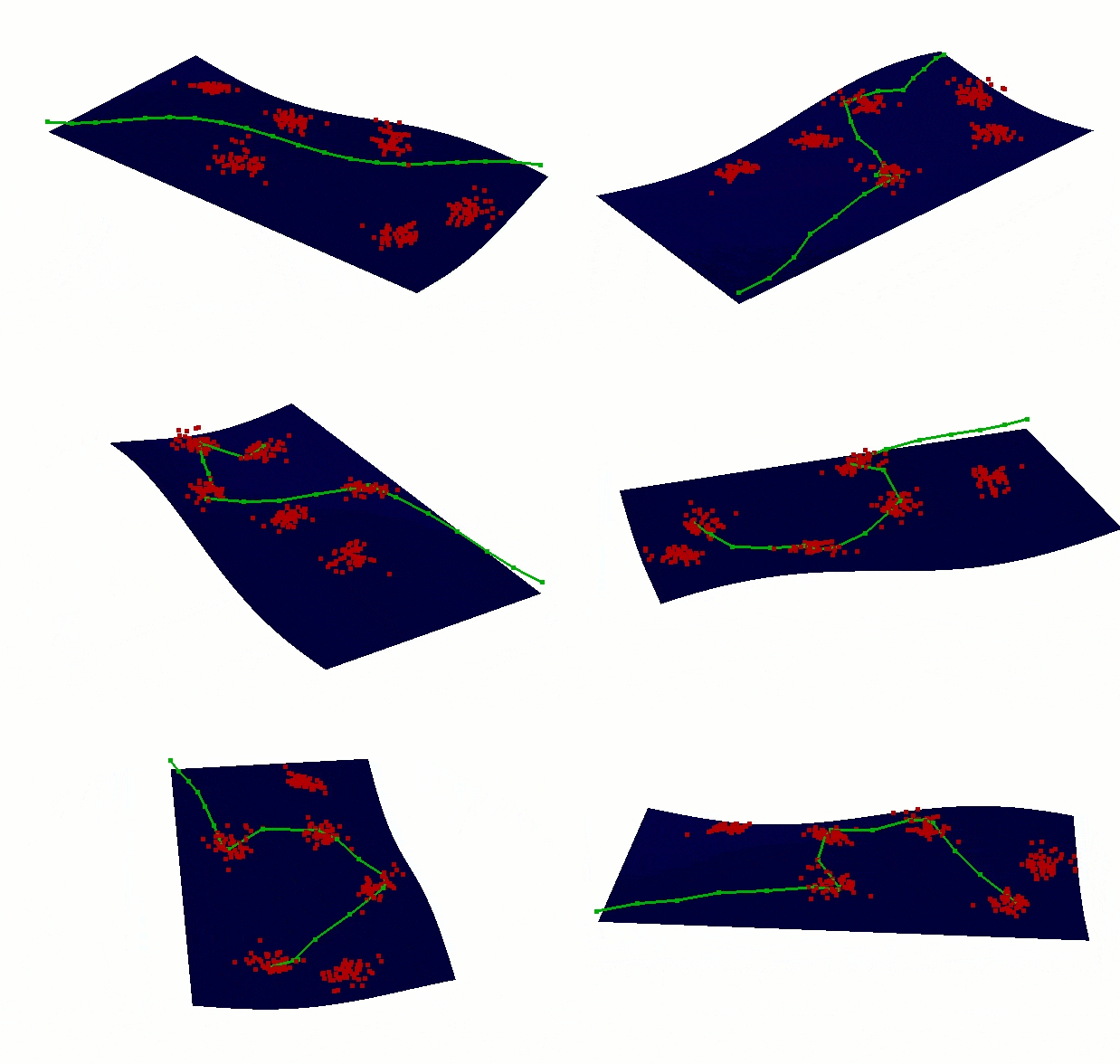
Electrical line design to connect households to the new power plant
Building a graph
From detailed street network to an efficient graph
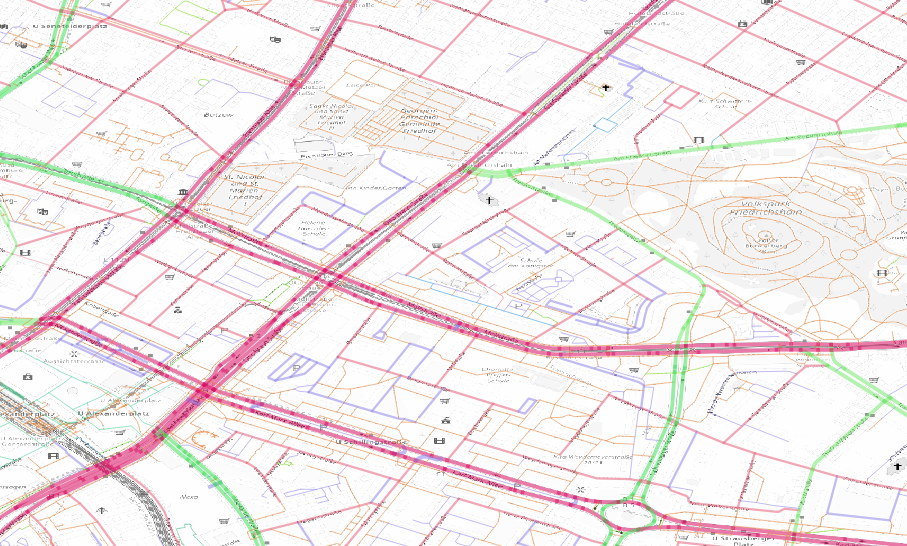
Subset, connect, simplify, subgraph, check directions...
weighting
Weight every segment
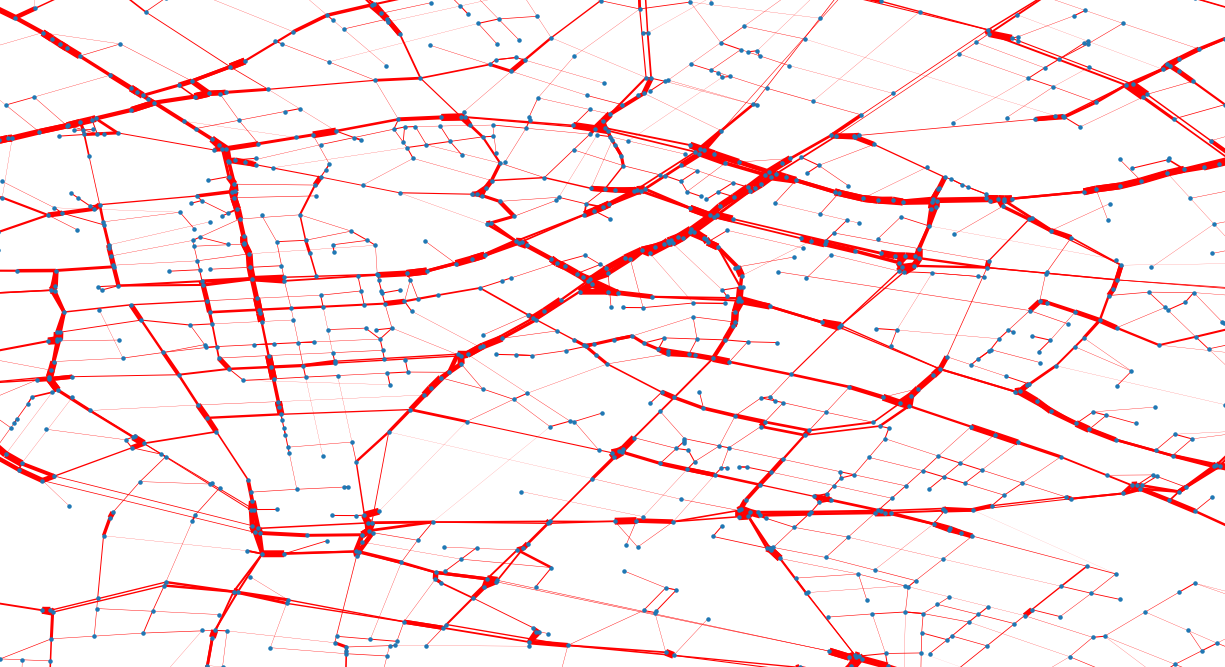
Maxspeed, streetclass, length, junctions
Graph setup
Checking routes

checking routes
Good correlation between spot2spot
routes in graphs and air distance
Osrm – open street routing machine
Routes
Subset the city in geohashes (~70m)
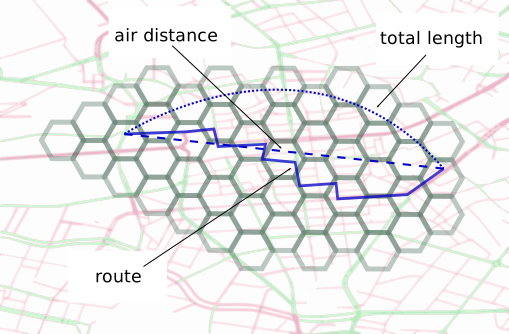
routing information
Calculate all pair distances and build a lookup database
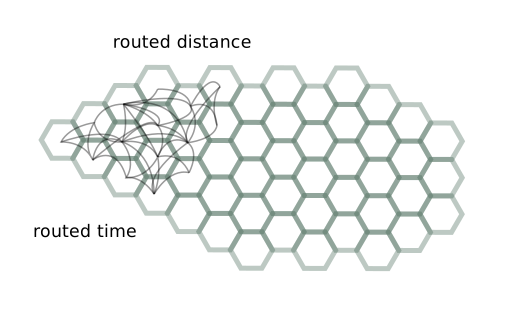
pair relationship database
Tasks
Sum up tasks in the same geohash
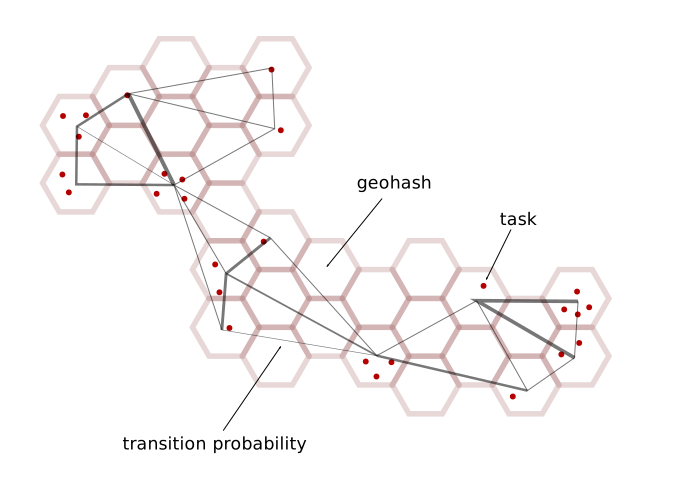
graph edges kept
Keep only neighbor connections between tasks
Sense move reward
Ant/colony
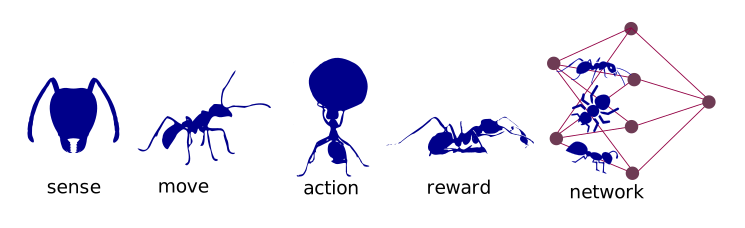
an ant per loop, iterate over the network
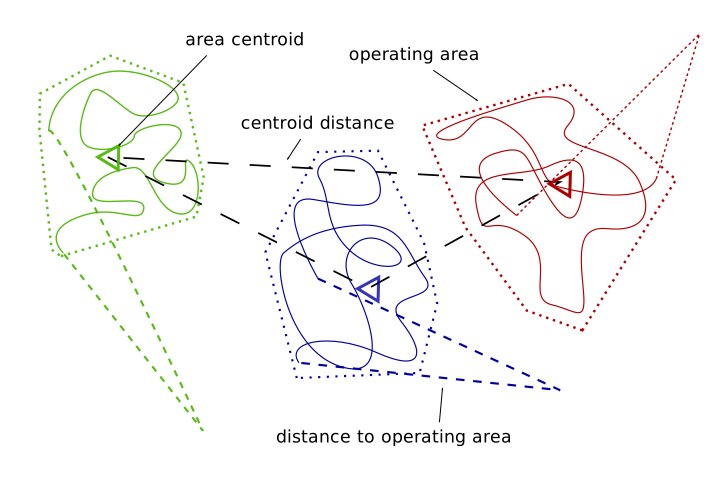
energy definition
Energy:
* +separation
* +task value
* - area
* - task time
* - tot distance
Path/network
An ant connecting each task
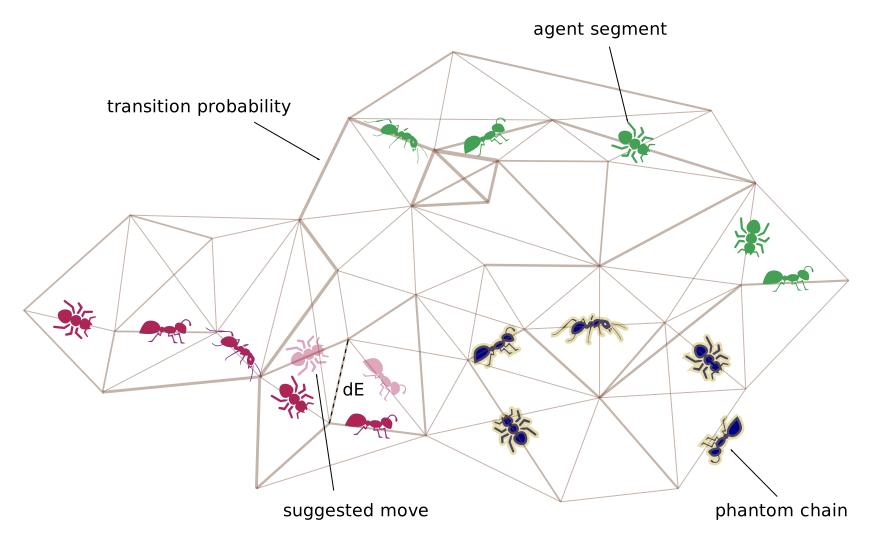
antani concept
Path opt
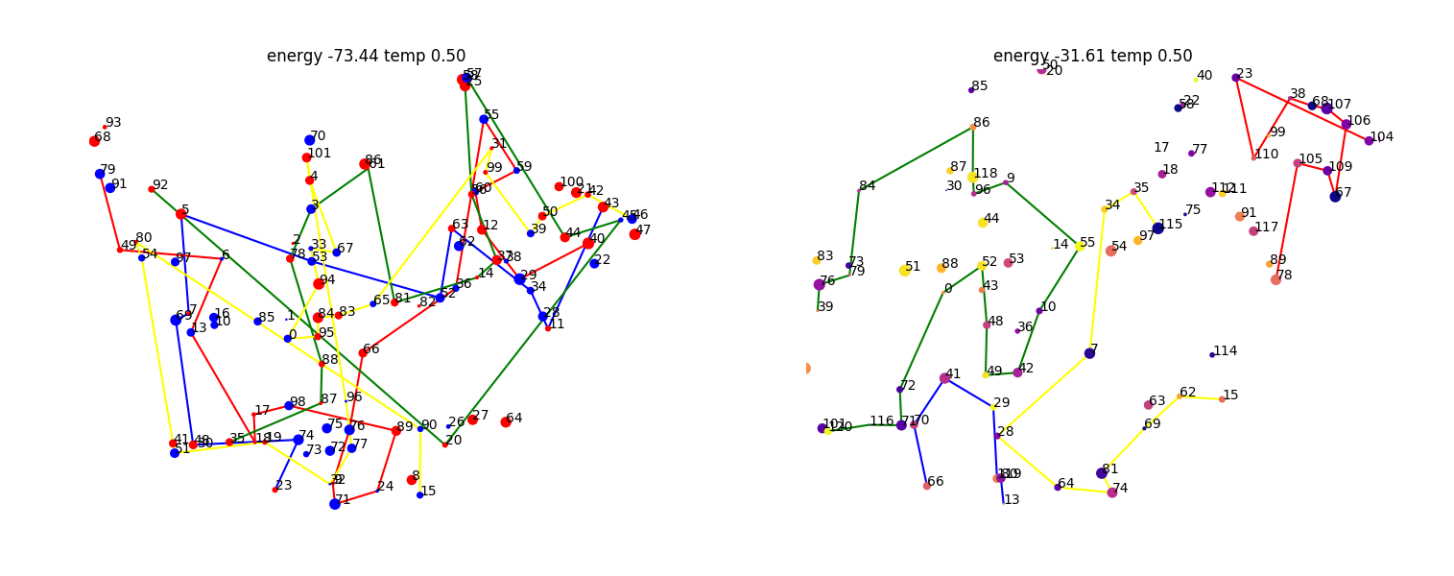
optimize sequences
Monte Carlo
Single random move
energy evolution
Asyntotic energy and move acceptance rate evolution
Markov Chains
Transition probabilities, limit links
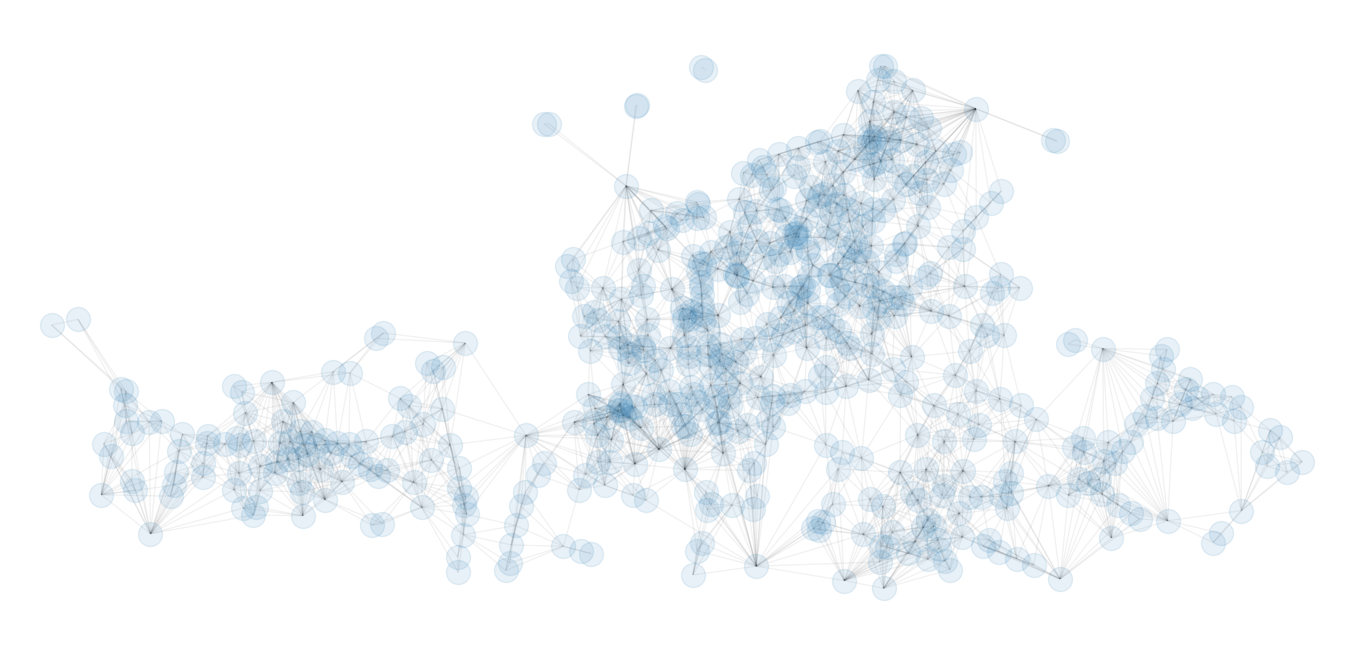
markov chains
We limit the possible moves leaving the most probable
Enhance moves
single, Markov, distance, extrude
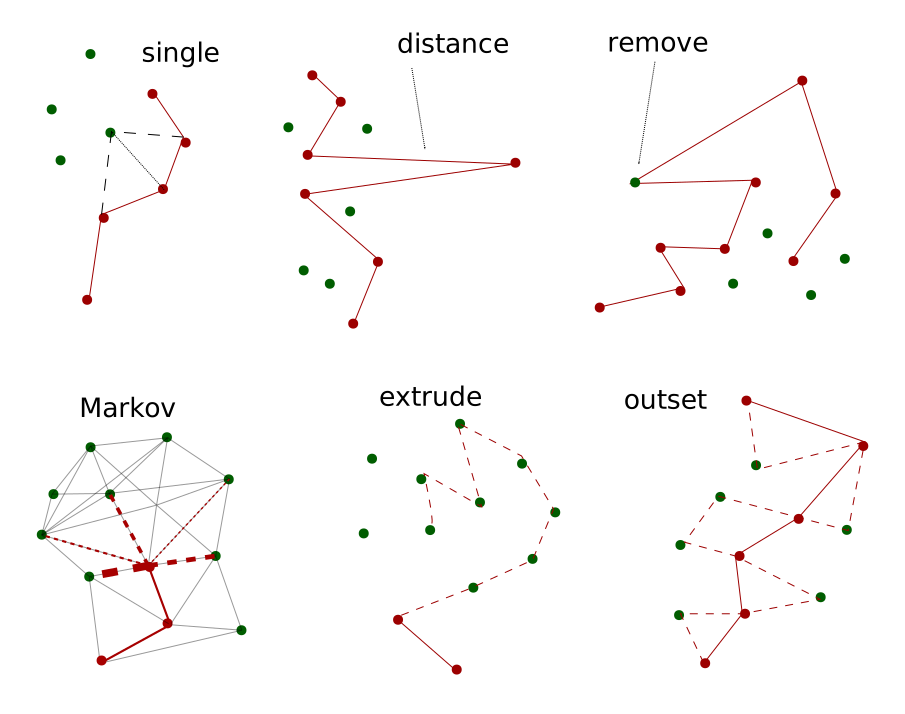
move selection
Spot selection according different probabilities
Simulation boost
- Faster convergency
- Higher acceptance
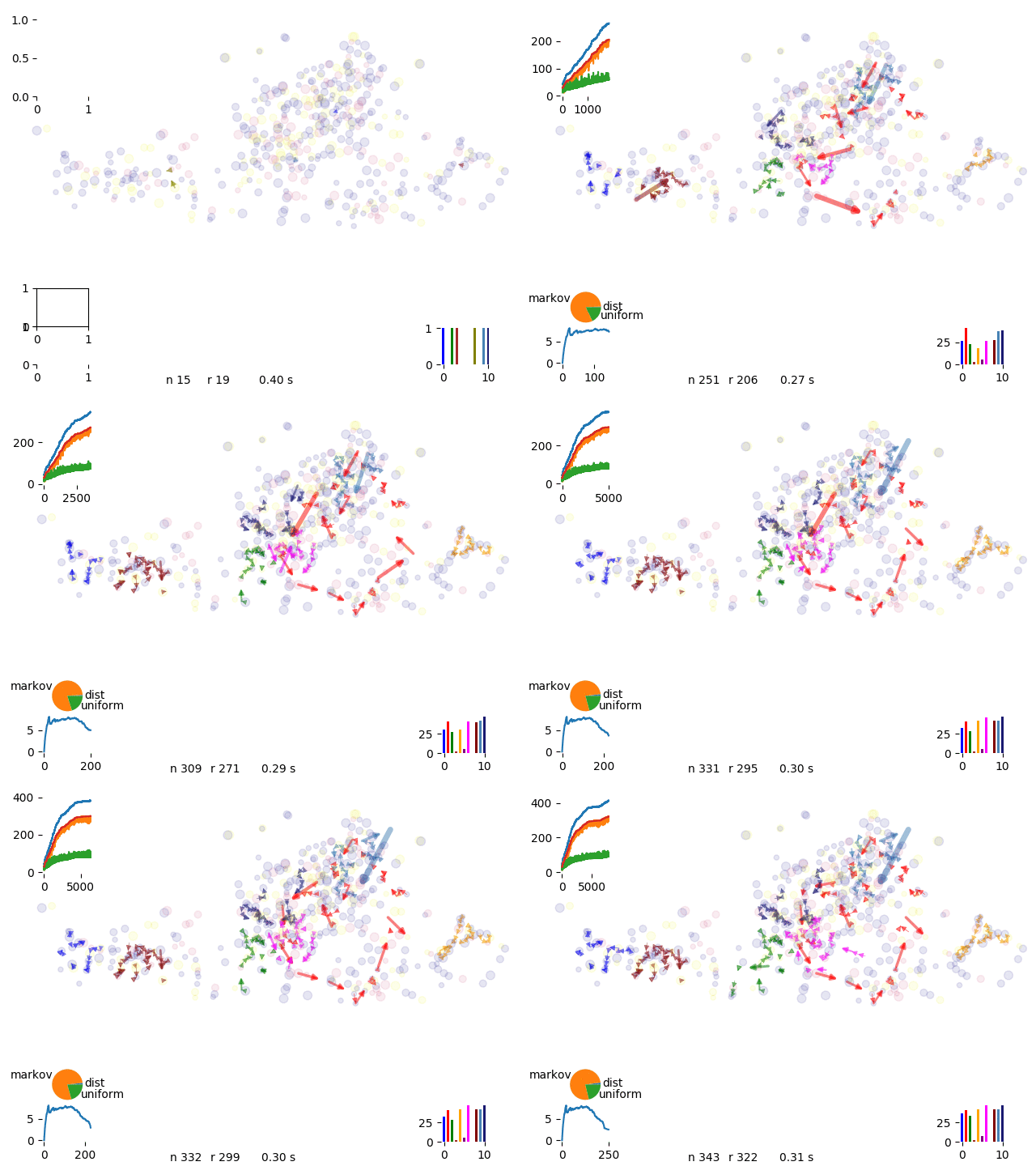
Single move, routific optimization, Markov chain, extrusion, grand canonical...
Calculation time
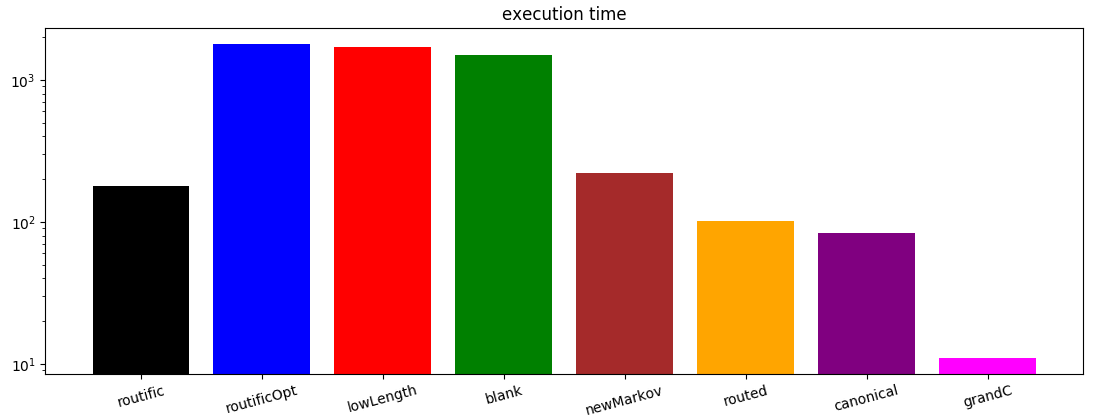
Early simulations were too slow
Find a score:
scoring
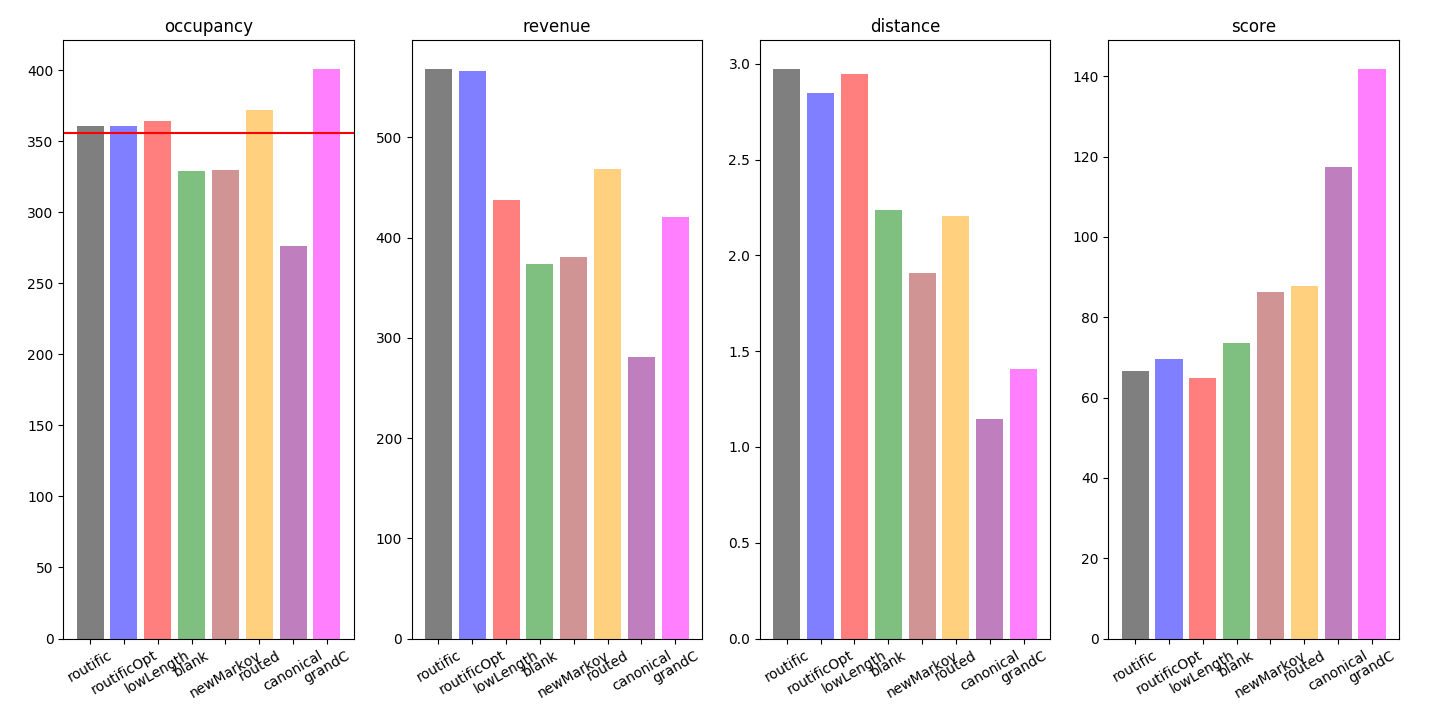
kpi comparison
+completion + revenue – distance - time
Reinforcement learning
Improve acceptance
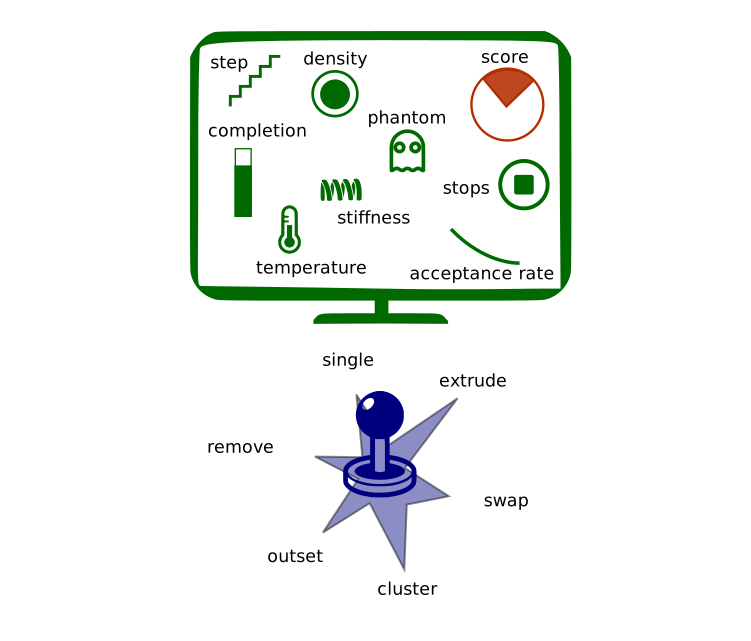
reinforce moves
Single agent reinforcement is too slow and chaotic
Posterior probability
Improve with real data
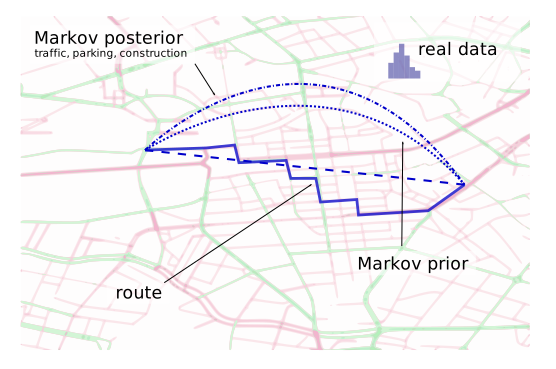
posterior probabilities
Demand
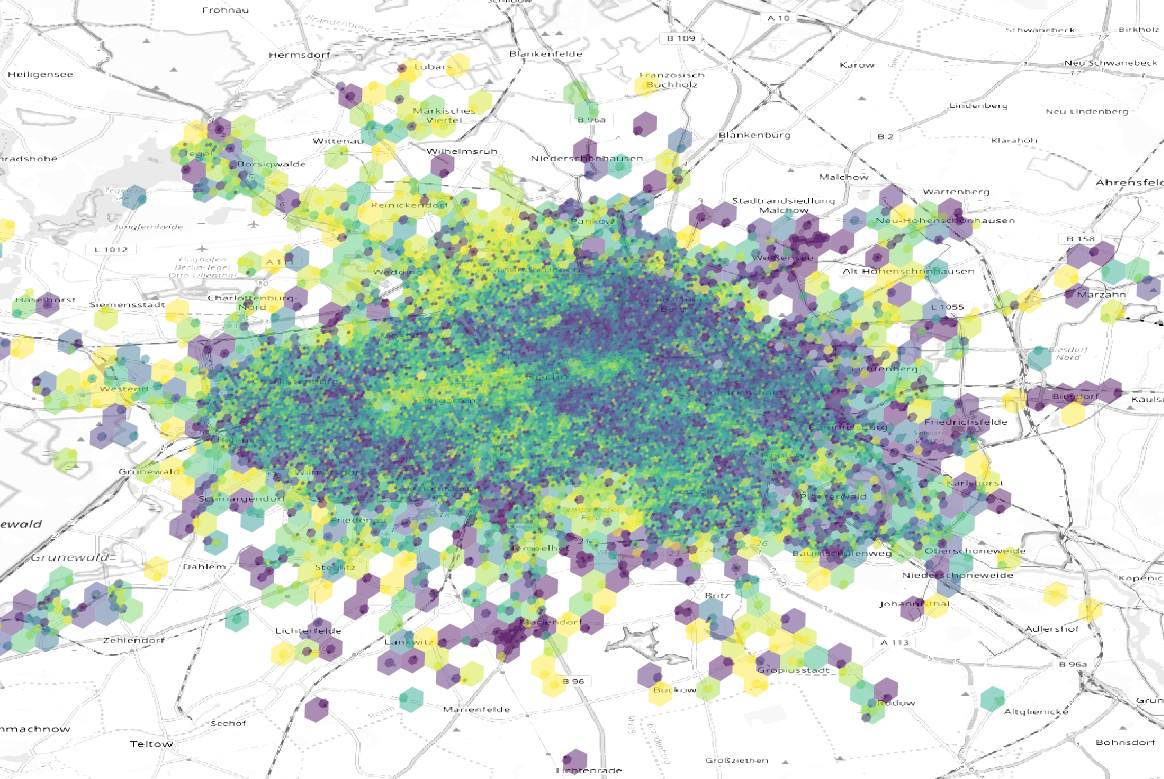
demand forecast
Microservice design
Backbone +microservices
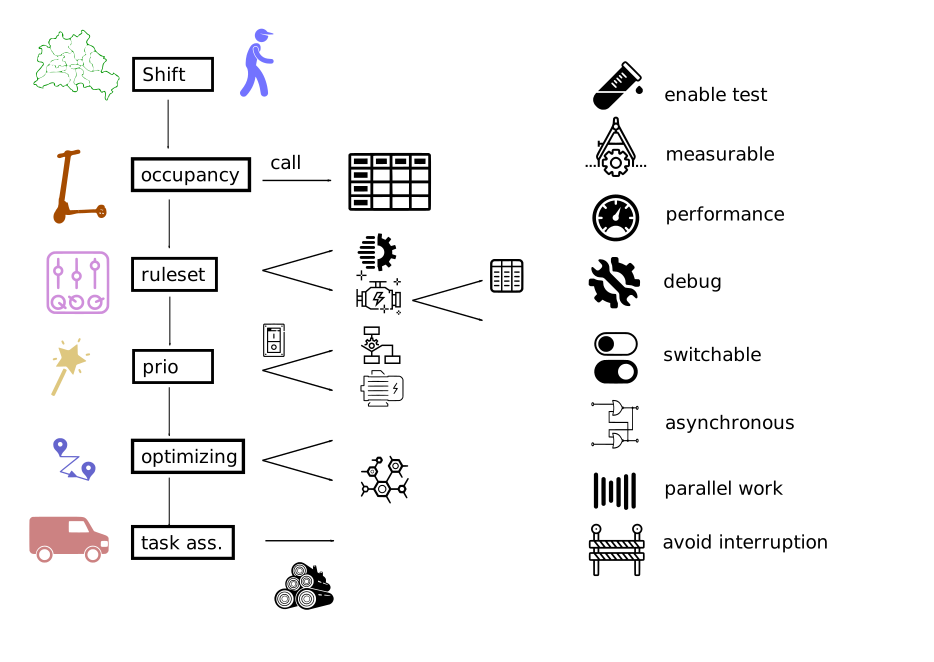
engine design
Asynchronicity
Docker, flask, redis,celery
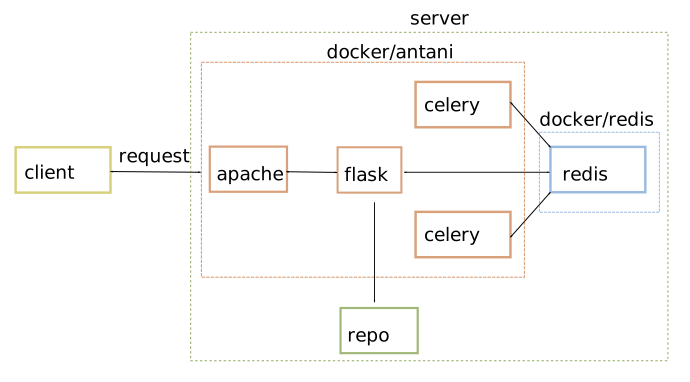
antani infrastructure
Client – broker/worker design
Frontend
OpenLayers, d3, ajaxDocumentation
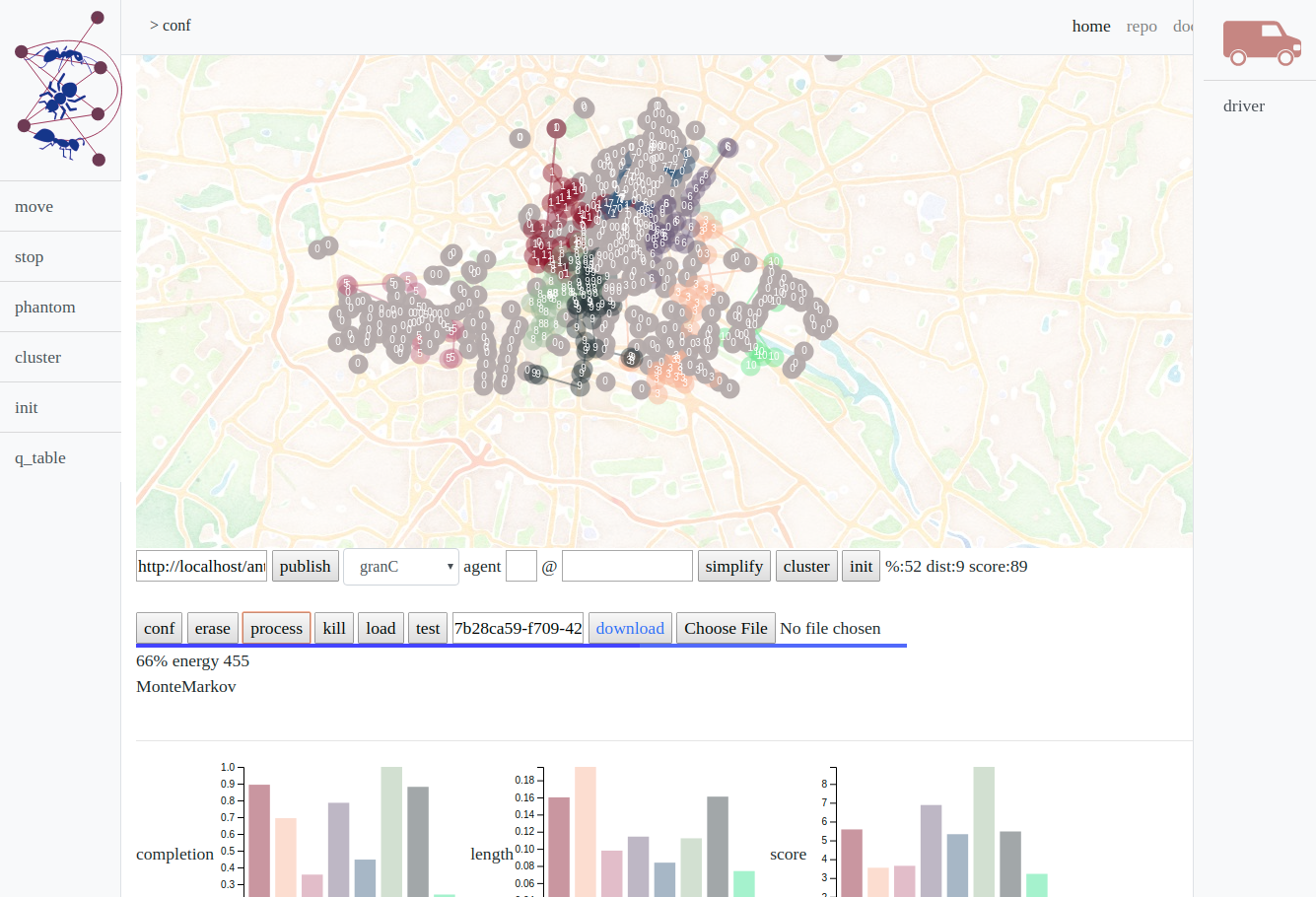
antani frontend
Documentation
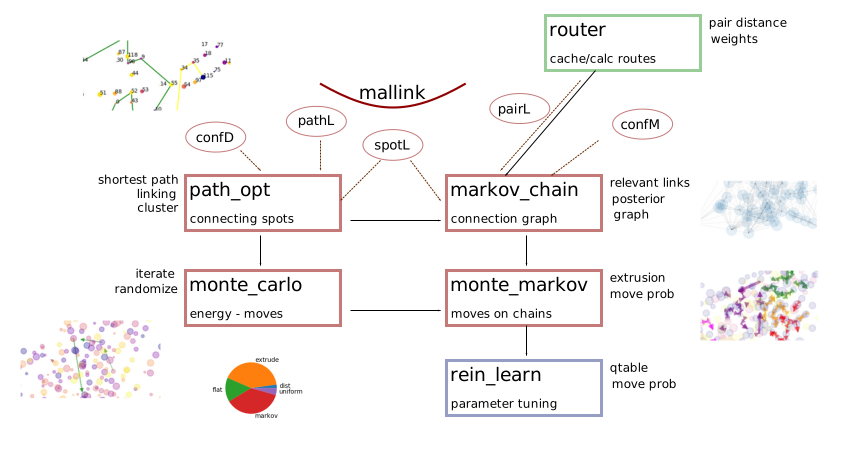
module mallink
Code

library ecosystem
...started in 2006
Outlook
- Ready for spring
- Drivers feedback
- Process real data
- Compare with rideos
- ...
Summary
- Start, stop, resume
- First draft within few seconds
- Clear operating areas
- Weighting potential revenues
- Focus on profitability
Acknowledgement
Circ – fleet engine team
Carlo Mazzaferro – productization of antani
Theory
Gibbs sampling
We describe a probability distribution via its moments $\vec{\mu}$
$$ p(\vec{x};\vec{\mu}) $$
We have a system $\vec{x}$ where each $x$ is in a certain state $s$. We define a energy function which depends on the states of system and a set of parameters $\theta$. In our case the system is a series of field tasks on a map and the state is the agent who is fulfilling the task.
The energy of the system is the sum of the revenue per task minus the cost: task time and path length. The parameter set $\theta$ defines the revenue and cost factor + external factors (temperature $T$, traffic time $h$,...). Ideally we will express the parameter set in terms of external factors $\theta(T,h)$ or change the metric (distance) of the system $d(T,h)$
$$ E_a(\vec{x}|\theta) = n_s\cdot r_s - c_d \cdot d_a - n_s\cdot t_s $$
where $n_s$ is the number of spots, $r_s$ the total revenue per spot, $t_s$ is the total operation time, $d_a$ the distance of that agent.
The probability distribution for a certain state and parameter follows the Boltzmann distribution
$$ p(\vec{x}|\theta) \propto exp(-E(\vec{x})/kT)
Target probability distribution
$$ p(\vec{x}) = \frac{w(\vec{x})}{Z} = \frac{1}{Z} \prod_c \phi_c(x)$$
estimator
$$ \frac{1}{T} \sum_{t=1}^{T} \phi(\vec{x}) \qquad E_{p(x)}|\phi(x)| = \sum_x p(x)\phi(x) $$
From the state $\vec{x}$ we create a state $\vec{x}'$ where we create a sample $x_j \rightarrow x_j'$, basically: $\vec{x}' = {x_1,x_2,...,x_j',...,x_n}$
$$ p(x) = \frac{exp(E(x)/T)}{Z} $$
$$ A(x'|x) = min(1,p(x')/p(x)) = min(1,exp(\frac{ E(x') - E(x)}{T})) $$
Bayesian statistics
We want to calculate the posterior probability doc which is the probability of a parameter set $\theta$ from a given state $X$
$$ p(\theta|x) = \frac{l(x|\theta)p(\theta)}{p(x)} $$
where $l(x|\theta)$ likelihood, $p(\theta)$ prior, $p(x'|x)$ the probability to move from state $x$ to state $x'$ and $p(X)$ normalization factor
$$ p(X) = \int d\theta p(X|\theta ) p(\theta*)$$
The likelihood is about finding the momenta of the distribution for a given data set (usually via regression), the probability distribution is the theoretical distribution for the system (independent on the data acquired). In a correct sampling the two match.
proposal distribution $p(x)$ - target distribution $g(x) ~ p(\theta|X)$
Step increment $\theta' = \theta + \Delta\theta$
$$\rho = \frac{g(\theta'|X)}{g(\theta|X)} \qquad \rho = \frac{p(X|\theta')p(\theta')}{p(X|\theta)p(\theta)}$$
sampling from probability from a state x doc
$$ x \tilde \pi(x) $$
High dimensional computing (over all states)
$$c = E[f(x)] = \int \pi(x) f(x) ds $$
optimization
$$ x* = argmax \pi(x) $$
Learning and Bayesian hierarchical modeling for a given parameter set $\Theta$
$$ \Theta * = argmax l(\Theta) ; l(\Theta) = \sum_{i=1}^{n} log p(x_i;\Theta) $$